




You're probably in a familiar spot. Early growth came from founder hustle, a few good campaigns, maybe some referrals, maybe one channel that worked better than expected. Now growth is less predictable, your team is stretched, and every week you delay a decision costs momentum.
That's when founders start looking for a digital marketing agency for startups. The mistake is thinking the job is to “find a good agency.” It isn't. The job is to run a disciplined selection process, structure a low-risk test, and manage the relationship like a growth system.
Your Startup Is Ready to Scale But Are You Ready for an Agency
A plateau usually doesn't look dramatic. Revenue still comes in. Traffic still moves. Your ads aren't dead, your emails aren't broken, and your team is still shipping. But the easy wins are gone, and internal bandwidth isn't enough to create the next growth step.
At that point, hiring outside help can be smart. It can also be expensive confusion if you outsource before you know what you need. The digital marketing agency market generated $598.58 billion in revenue in 2024 and is projected to reach $1,443.27 billion by 2034, growing at a 9.20% CAGR, according to marketing agency industry statistics. That tells you two things. First, agencies are now a core part of how modern companies grow. Second, there's a lot of noise around something that matters a lot.
Most founders start too late or too loosely. They wait until CAC feels uncomfortable, then ask three agencies for proposals and compare decks that aren't built on the same assumptions. That usually leads to buying confidence, not capability.
Practical rule: Don't start with “Which agency should we hire?” Start with “What growth problem are we hiring this agency to solve?”
If your team still needs to tighten fundamentals, a resource like digital marketing tips for small business can help frame the basics. But once you're spending serious money, you need more than tips. You need operating discipline.
That discipline starts with your internal brief. Before an agency touches your ad account, email platform, analytics, or landing pages, your team should already know where acquisition is leaking and where retention is weak. If CAC pressure is part of the trigger, it helps to align internally around ways to reduce customer acquisition cost before you bring a partner into the mix.
Define Your Mission Before You Seek a Partner

Founders often say they want “more growth.” Agencies hear that and fill in the blanks with whatever they sell best. That's how you end up buying content when you needed conversion work, or paid media when the underlying issue was weak post-purchase retention.
Write a one-page mission brief before you contact anyone. It should answer three questions clearly.
Name the business outcome
The first line should be a business target, not a channel request. Better examples:
- Improve repeat purchase behavior if you're an ecommerce brand with healthy first-order volume but weak retention
- Increase qualified pipeline if your issue is lead quality, not lead quantity
- Recover conversion efficiency if spend is rising and blended results are slipping
- Launch a reliable testing engine if your team has traffic but no experimentation rhythm
A digital marketing agency for startups should tie work to business movement. If they can't connect tactics to revenue quality, speed of learning, or customer value, they're pitching activity.
Pick the primary lever
Most startups shouldn't hire for four channels at once. They should identify the one or two levers most likely to move the business now.
That's why channel specialization matters. Startup agency research focused on ecommerce notes that email marketing yields a 42x ROI, and for DTC brands, specialized email agencies can drive a 25 to 40% revenue uplift. If you're an ecommerce founder dealing with rising acquisition costs, that matters. A broad agency may offer email as one line item. A specialist treats it as a profit center.
Use this filter:
- If traffic is strong but conversion is soft, prioritize CRO and messaging.
- If first orders happen but repeat purchase is weak, prioritize email and retention.
- If your offer converts and you need scale, prioritize paid acquisition.
- If paid spend is too dependent on short-term buying, build content and SEO in parallel.
A lot of bad agency relationships start with a vague brief and a broad scope. Focus is what makes the partnership useful.
After you've written the mission brief, review this walkthrough before interviews:
Set budget rules before proposals arrive
Proposal comparison gets distorted when founders haven't set budget boundaries. Agencies sense uncertainty and shape scope around it. You need a simple internal rulebook.
Use a shortlist like this:
- Define the total test budget your team is comfortable risking over an initial engagement
- Separate media spend from agency fees so you can evaluate efficiency transparently
- Protect implementation bandwidth because your team will still need to review copy, approve creative, and join reporting calls
- Document essential requirements such as platform access, asset ownership, reporting access, and response times
If you can't explain what winning looks like before the first call, no agency can build a useful plan for you.
Comparing agencies? Ask how they measure revenue, not opens. Book a free 30-minute strategy call →
Choose Your Agency Model and Core Services
The biggest structural mistake startups make is hiring a full-service agency before they've earned the complexity. Breadth sounds safe, but early-stage growth usually comes from one strong engine and one supporting system.

Specialist versus generalist
A specialist agency is often the better choice when your problem is obvious. If your store gets traffic but doesn't retain buyers, hire retention expertise. If paid search is your growth engine and performance has stalled, hire a paid acquisition team with deep account experience.
A generalist can work when you already have internal marketing leadership that can coordinate priorities across channels. Without that, broad scope often produces diluted execution.
The risk of going too broad is well documented. Startup agency benchmark analysis says startups using generic, cookie-cutter tactics report less than 200% ROI, compared with 400% for customized strategies. That gap matters more than any logo on a pitch deck.
What each core service is really for
Don't evaluate services by what they are called. Evaluate them by the business problem they solve.
| Service | Best use case | Common mistake |
|---|---|---|
| Paid acquisition | You need faster demand capture and already know your offer converts | Scaling spend before landing pages and offer clarity are ready |
| Email and retention | You need to increase repeat orders, recover carts, and improve customer value | Treating email as newsletters only |
| CRO | You have meaningful traffic but weak conversion from visit to purchase or lead | Running ad tests while the site still leaks conversions |
| Content and SEO | You want compounding demand and stronger category authority | Expecting immediate performance like paid media |
How to prioritize without overbuying
Start with the bottleneck. Not the wishlist.
If you run ecommerce, one practical split is:
- Retention first when the brand already has order volume and weak lifecycle automation
- Paid media first when conversion is healthy and demand volume is the problem
- CRO first when neither traffic nor retention work as expected because the funnel itself is underperforming
If you need help understanding what agency service categories include, a service breakdown like ecommerce growth services for retention and conversion is useful as a scoping reference. Not because you should buy everything, but because you should know what each workstream includes before you compare proposals.
A startup usually needs depth before breadth. One excellent channel with clean measurement beats five partially managed channels every time.
What a strong agency model looks like
Strong startup agencies usually do a few things consistently:
- They narrow the first engagement. They don't insist on touching every channel on day one.
- They explain trade-offs. If they recommend paid media, they should also tell you what has to be true on the site or in retention for that to work.
- They tailor by business model. A DTC beauty brand, a subscription business, and a B2B SaaS company should not get the same plan.
- They show relevant proof. Not generic success. Relevant category, offer, and growth-stage experience.
What doesn't work is the agency that sells “full funnel growth” but can't tell you where your next dollar should go first.
Your Agency Vetting and Interview Kit
Most agency interviews are too polite. Founders ask about process, reporting, and communication. Agencies answer smoothly because they've practiced those answers for years. A better test is whether they can think clearly under uncertainty and explain how they learn.
The best agencies operate with a testing mindset, not a presentation mindset. This review of startup-focused agencies describes a growth squad model that can yield 2 to 5x ROAS, and notes that 75% of tests should yield actionable insights within two weeks. That's the standard worth probing for. You're not hiring slide-making. You're hiring disciplined iteration.
Where to find better candidates
Google search still has a place, but warm referrals and vetted directories usually produce better starting lists. The goal isn't finding the most visible agency. It's finding the one whose operating model matches your stage.
Look in a few places:
- Founder referrals: Ask founders with a similar business model what they hired the agency to fix.
- Operator communities: Marketing leads often share which agencies are strong on execution versus account management.
- Clutch and similar directories: Useful for spotting patterns in responsiveness, niche focus, and client mix.
- Your own stack partners: Sometimes your email platform, analytics consultant, or paid media freelancer knows who does good work.
Agency Evaluation Checklist
| Evaluation Area | What to Look For | Red Flag |
|---|---|---|
| Team structure | You know who will manage strategy, execution, creative, and reporting | Senior seller closes the deal, junior team appears later |
| Testing process | Clear explanation of hypotheses, test cadence, decision rules, and what gets paused | Vague language about “continuous optimization” with no mechanics |
| Channel depth | Specific experience in your business model and growth stage | Broad promises across every channel with little specificity |
| Reporting | Live dashboard access, plain-English summaries, and business-linked KPIs | Reports centered on impressions, clicks, and platform screenshots |
| Communication rhythm | Weekly working cadence and scheduled strategic reviews | “We'll update you as needed” |
| Data access | You keep admin access to platforms, audiences, creative files, and historical data | Agency wants to run everything through its own accounts only |
| Contract terms | Clear scope, ownership, exit terms, and review points | Long lock-in without a performance review checkpoint |
| Problem solving | Honest examples of what failed and how they adapted | Only polished wins, no lessons, no trade-offs |
Questions that expose real capability
Ask questions that require detail. Good agencies usually answer directly and can point to how they work without hiding behind jargon.
Use questions like these:
- Walk me through a campaign that underperformed. What was the original hypothesis, what broke, and what changed next?
- How do you decide what to test first? Listen for prioritization logic, not buzzwords.
- What should we expect you to learn in the first month? You want a learning agenda, not guaranteed wins.
- What do you need from our side for this to work? Mature agencies know client-side bottlenecks matter.
- How do you separate signal from noise? They should talk about decision discipline and avoiding vanity metrics.
- What does reporting look like when results are mixed? You need honesty, not spin.
The strongest answer in an agency interview is often “We wouldn't start there.” Good partners push back.
Contract risks founders overlook
Founders usually focus on price. The more dangerous issue is structure.
Watch for these contract problems:
- Open-ended scope: If the scope isn't narrow, accountability gets fuzzy fast.
- No review gate: There should be a formal point where both sides assess whether to continue.
- Weak asset ownership language: You should retain access to what gets built.
- Payment terms you haven't stress-tested: Before you sign, it's worth reviewing Redline contract scanning for payment risks so your team spots clauses that create pressure later.
A good contract won't guarantee performance. It will make underperformance easier to identify and easier to exit.
Design a Pilot Project to Predict Success
A long contract before proof is a founder mistake. A better move is a paid pilot with a narrow scope, clear deliverables, and a hard review point.
The pilot should be long enough to generate learning, short enough to limit damage, and specific enough that both sides can tell whether the work is improving the business. For most startups, that means a 90-day pilot.
Keep the scope tight
Don't ask an agency to “handle growth” in the pilot. Ask them to improve one system.
Good pilot scopes look like this:
- Email retention scope: Audit lifecycle gaps, optimize a welcome series, launch an abandoned cart flow, and improve reporting on retention performance
- Paid media scope: Audit existing account structure, rebuild one campaign family, test new creative angles, and tighten landing page alignment
- CRO scope: Review a core funnel, prioritize friction points, ship focused page tests, and document wins and losses
Bad pilot scopes mix too many moving parts. If the agency rewrites your messaging, rebuilds your landing page, changes your targeting, refreshes creative, and shifts your offer all at once, you won't know what drove results.
Define success in advance
A pilot needs decision criteria before kickoff. Otherwise every review meeting becomes a negotiation.
Use three layers of KPI evaluation.
Execution KPIs
Did the agency deliver the agreed work on time, with usable quality, and with clear communication?Learning KPIs
Did the team generate insights that changed how you understand the funnel, offer, audience, or creative?Business KPIs
Did leading indicators improve in a way that supports your original mission?
For ecommerce brands, this is also where conversion work and retention work often meet. If your pilot touches on page performance, use a practical benchmark set tied to conversion rate optimization for ecommerce so the agency's experiments map to buyer behavior, not just ad platform metrics.
What to put in the pilot agreement
Keep the document simple and operational.
Include:
- A narrow problem statement
- Exact channels and assets in scope
- Named deliverables
- Meeting cadence
- What data and platform access each side provides
- Success criteria
- A go or no-go review at the end of the pilot
If the pilot can't fail on paper, it can't succeed meaningfully either.
How to judge the pilot fairly
The wrong way is to judge only by top-line results. The right way is to ask whether the agency improved the system.
A strong pilot often shows up through signals like cleaner reporting, sharper hypotheses, faster iteration, better creative logic, and clearer channel economics. Sometimes those lead to visible commercial wins quickly. Sometimes they set up the next quarter. Both can be valuable, but only if you agreed on that reality before work started.
The First 90 Days An Onboarding and Measurement Playbook
A startup doesn't get agency value from signing a contract. It gets value from reducing ambiguity fast. The first 90 days decide whether the relationship becomes a growth asset or a recurring management problem.
Clutch's review of startup-focused digital marketing agencies notes that successful partnerships can deliver 240% revenue increases over two years and 10x growth in organic and email traffic, and that structured onboarding is the first step toward those outcomes. That matches what strong operators already know. Early clarity compounds.
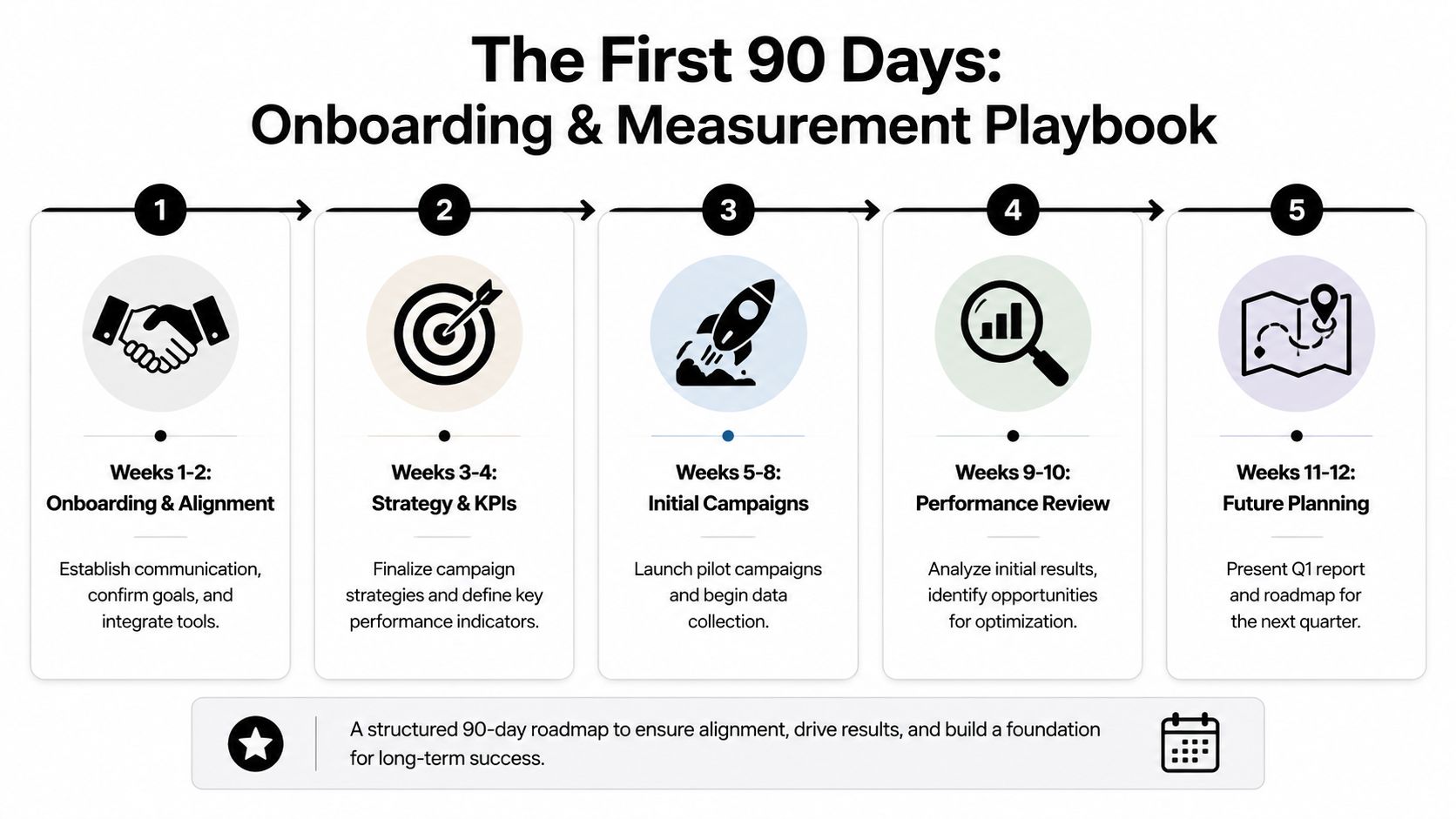
Weeks 1 and 2 alignment work
The kickoff call should include the people who can unblock execution. Usually that means the founder or marketing lead, whoever owns analytics, someone who can approve creative quickly, and the agency's day-to-day operator.
Use the first two weeks to lock down:
- Goals and definitions: Make sure “conversion,” “qualified lead,” “repeat customer,” and other core terms mean the same thing to both sides.
- Tool access: GA4, Meta Ads, Google Ads, Klaviyo, Shopify, Mixpanel, creative folders, historical reports.
- Decision owners: Who approves copy, creative, landing page edits, and budget changes.
- Communication rhythm: Weekly working session, async updates, and a monthly strategy review.
If this stage feels slow, that's normal. Sloppy access and unclear ownership create problems that look like performance issues later.
Weeks 3 through 8 build and launch
Weak agencies often hide behind setup. Strong agencies move from audit to action quickly, but they don't skip instrumentation and baselines.
A healthy middle stretch usually includes:
- A concise audit readout focused on the few issues worth acting on first
- A testing roadmap ranked by likely impact and effort
- Initial launches with clear documentation of what changed and why
- A reporting view that strips out vanity metrics and surfaces decision metrics
Don't ask for more reports. Ask for fewer metrics with better decisions attached to them.
Weeks 9 through 12 review and decide
By this point, you should be able to answer three questions with confidence.
| Question | What a good answer sounds like |
|---|---|
| Did the agency execute? | Work shipped on time, the team communicated clearly, and there were no surprises around ownership or access |
| Did the agency learn? | The team can explain what they tested, what happened, and what the business should do next |
| Should we expand the scope? | The answer is based on evidence, not optimism |
Your weekly dashboard should stay lean. A useful version usually includes:
- Primary business KPI: the core outcome tied to the mission
- Channel KPI: the main indicator for the pilot channel
- Efficiency KPI: how much effort or spend is required to produce the result
- Conversion KPI: where buyers are moving or dropping
- Retention KPI: especially important for ecommerce and subscription models
- Experiment log: what launched, what was paused, what was learned
For ecommerce teams, a working reference for what belongs on that dashboard is ecommerce performance metrics that matter to growth decisions. The point isn't to track everything. It's to track enough to make the next call well.
The standard that matters
A digital marketing agency for startups should make your team sharper, not more dependent. After 90 days, you should have better reporting, better priorities, a clearer growth thesis, and enough evidence to decide whether to deepen the relationship.
If all you have is a prettier dashboard and a larger invoice, the pilot did its job by showing you what not to scale.
If your ecommerce brand wants a partner focused on retention, lifecycle automation, and owned-channel revenue, Ecommerce Boost is worth a look. They specialize in email marketing for online stores and help founders turn repeat purchase behavior into a more predictable growth engine.
Free 30-minute strategy call
See what an email partner should be delivering for you
We run email and SMS for 400+ ecommerce brands on Klaviyo and Omnisend. In 30 minutes we’ll review your account and show you what’s possible, whether or not you hire us.
$20M+ in email revenue generated for clients · 400+ brands · Klaviyo & Omnisend partner
Or explore our ecommerce email marketing services.
Prefer email to a call?
Tell us about your store and we’ll reply by email.
Four quick details. JP or the team will email you back with whether we’re a fit and how we’d approach your email and SMS. No call needed to start.


