




The most popular advice about an e commerce loyalty program is also the least useful: launch points, promote enrollment, and assume retention will follow. It won't. A points balance is only a liability until it changes what a customer does next, and a large member list can hide flat repeat purchasing.
Loyalty programs are already embedded in retail. By 2020, more than 90% of companies had some form of loyalty program, while consumers in the United States held 3.3 billion memberships. The average consumer belonged to 14.8 programs but was active in only 6.7, according to Forbes' loyalty program analysis. The competitive question isn't whether your brand has a program. It's whether your program earns a second purchase sooner, more often, or at better economics.
Why Most Loyalty Programs Fail Before They Launch
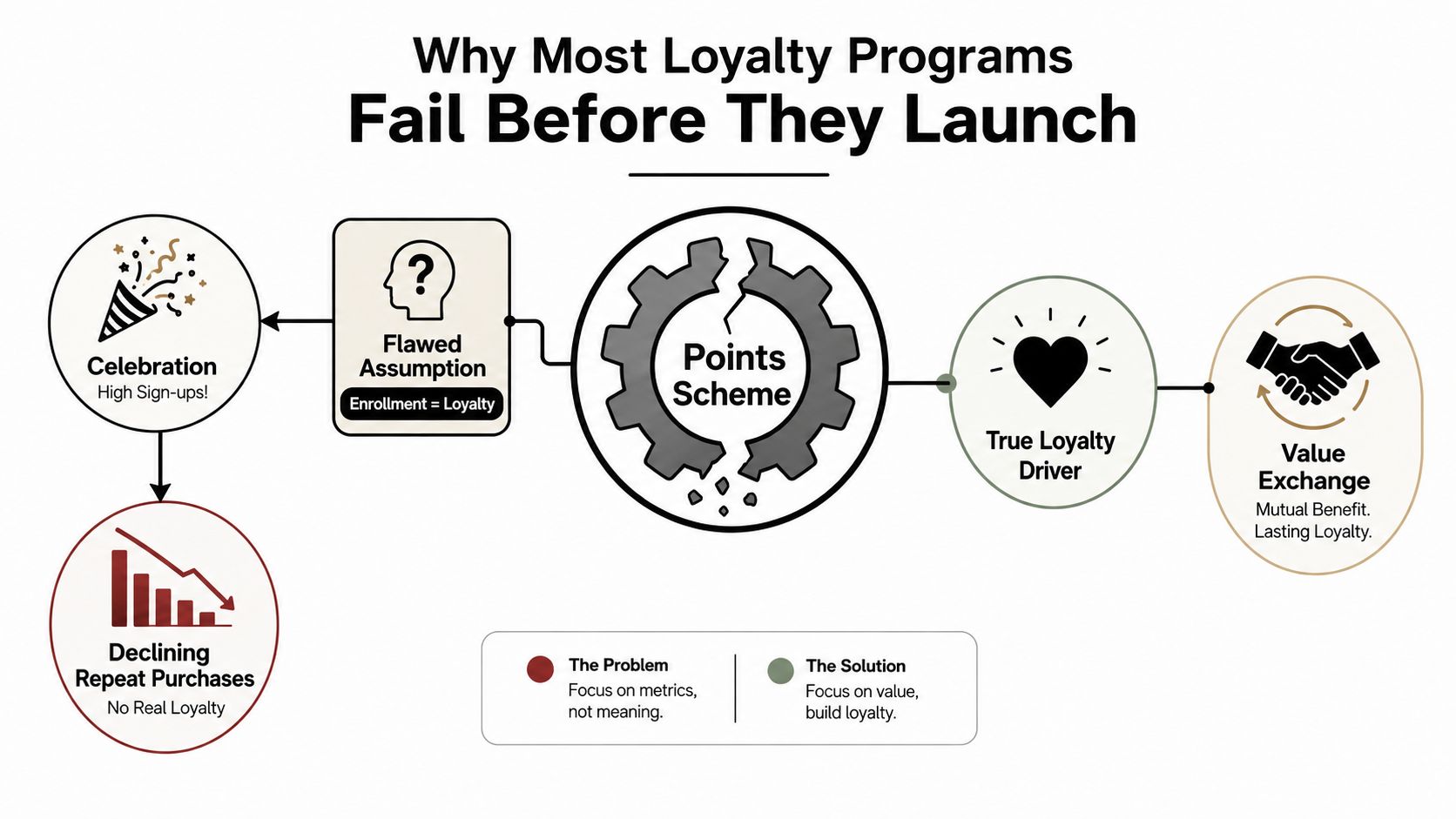
A points program is a mechanism. A loyalty program is a behavior-change system. Confusing the two is how brands celebrate registrations while repeat purchase rates remain unchanged.
The first failure appears when rewards duplicate public promotions. If a customer can get the same discount without joining, membership adds friction without adding motivation. The second happens when brands reward customers who were already going to buy. Those points reduce margin, but they don't create incremental revenue. The third is the tier structure built for a presentation rather than a customer decision. A tier that sits too far away feels irrelevant, while one that's too easy to reach creates cost without meaningful progression.
Retention rule: Every mechanic must answer one question, does it change repeat purchase rate, purchase frequency, or customer lifetime value?
Start with a baseline before choosing software or naming tiers. Segment customers by purchase history, margin contribution, product category, and time between orders. Then ask whether the proposed reward gives a customer a reason to return, or just gives an existing buyer a cheaper transaction.
A peer-reviewed meta-analysis covering 429 effect sizes found that loyalty program effectiveness varies with reward structure, delivery, and industry context, as documented in the Journal of the Academy of Marketing Science research. That matters because generic points aren't neutral. Reachable goals, clear progress, and appropriate reward timing can influence behavioral loyalty, while attitudinal loyalty is harder to shift.
Brands should also define retention marketing before they define points. The distinction is useful in this guide to retention marketing, where the focus belongs on repeat customer economics rather than isolated campaign engagement. Enrollment is an input. Incremental repeat behavior is the outcome.
The Core Mechanics of an E Commerce Loyalty Program
Every program has four practical building blocks. Think of a coffee stamp card that evolves into a frequent flyer account. The purchase earns progress, the currency records that progress, the reward makes progress spendable, and status gives frequent customers a reason to concentrate more activity with the same brand.
The earn rule
The earn rule decides what behavior receives value. Purchases are the obvious trigger, but reviews, referrals, account creation, subscriptions, or category-specific purchases can also qualify. Keep the primary rule easy to explain. If customers need a calculator to understand the benefit, the program has already lost momentum.
The point currency
Points are a deferred discount. They create a future reason to return, but they also create an accounting obligation and a margin question. A point has no motivational value unless customers understand what it can buy and how close they are to using it.
The redemption catalog
The catalog determines whether points feel useful. Discounts are easy to understand, but free shipping, products, early access, and member-only items can protect perceived value without applying the same pressure to every order. This is also where programs can leak margin, especially when brands offer rewards unrelated to inventory economics.
The tier layer
Tiers create a goal gradient. Customers can see a next status, understand the benefit, and decide whether the next purchase is worth making sooner or at a higher value. Tiers only work when the distance is credible and the benefit is distinct.
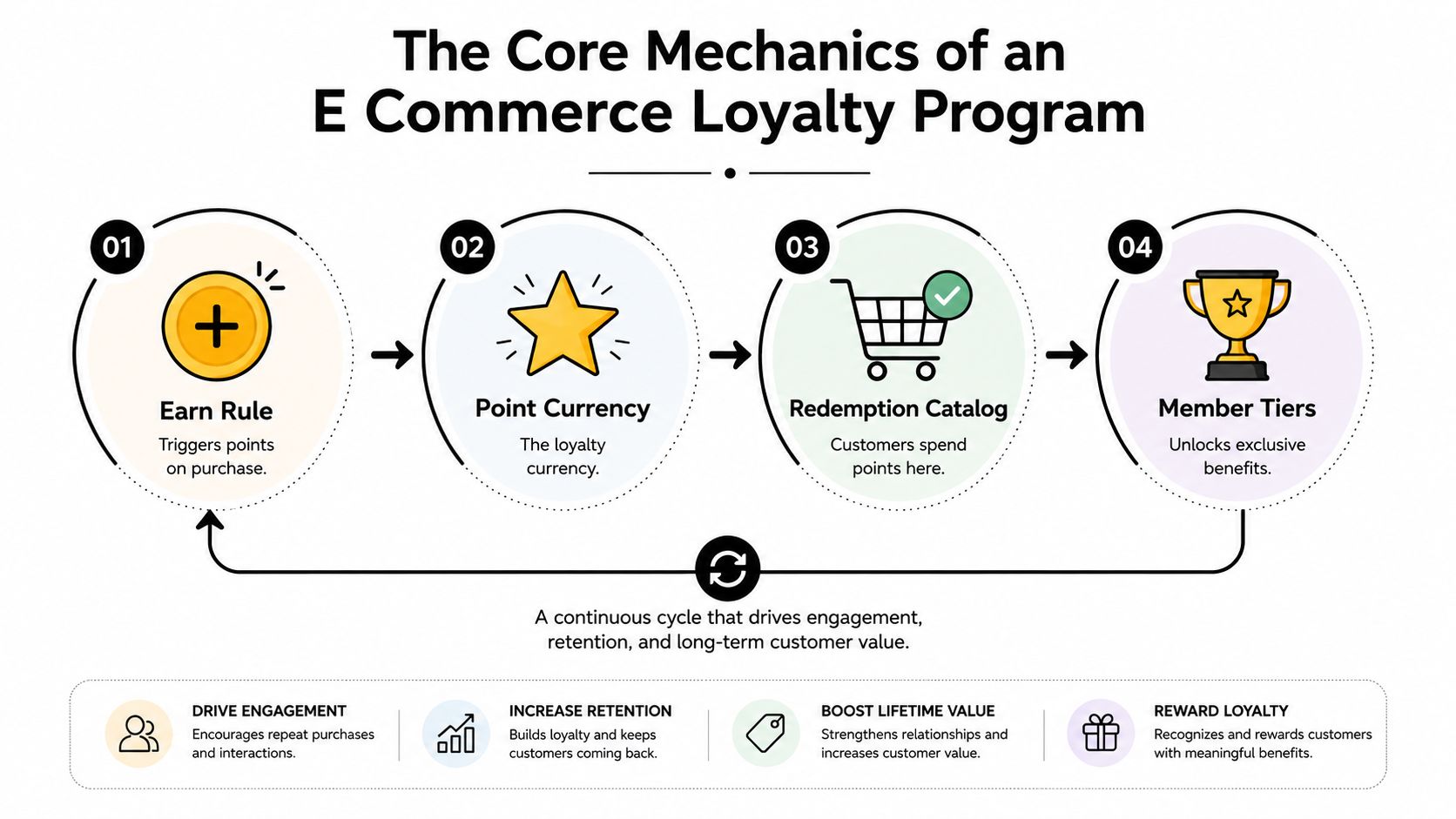
These elements form a loop. A customer earns, sees progress, redeems, and receives a reason to return. If the reward is unreachable, the loop breaks. If the reward is too generous, the brand subsidizes behavior that may have happened anyway. Teams evaluating operating costs should also compare the broader financial model through a pricing page for planning and forecasting tools, not just the visible cost of loyalty software.
Your customer lifetime value model should include reward cost, redemption behavior, incremental orders, and the margin of products purchased with rewards. A practical customer lifetime value modeling framework helps keep the program tied to contribution rather than activity counts.
The Main Program Types and When Each One Works
No format wins by default. The right structure depends on average order value, purchase timing, gross margin, and how much identity your brand already owns.
| Program Type | Best For | Required AOV Range | Repeat Cycle | Core Retention Mechanic |
|---|---|---|---|---|
| Points-based | Broad catalogs, frequent replenishment, simple value propositions | Match reward cost to margin, not a universal threshold | Frequent or predictable | Deferred value encourages the next purchase |
| Tiered | Higher-value orders and categories with a meaningful repeat need | Higher AOV or concentrated customer spend | Regular enough to reach status | Progression and status concentrate spend |
| Paid VIP or subscription | Brands with strong identity and recurring demand | Sufficient margin to fund exclusive benefits | Frequent or contract-like | Prepaid access and convenience create commitment |
| Value-based mission | Mission-led brands with existing community traction | Flexible, but the mission must feel credible | Variable | Emotional alignment and participation deepen attachment |
Points-based programs suit brands selling consumables, replenishment products, or broad catalogs where customers can return often. They should stay simple and use category rules when some products support better contribution than others.
Tiered programs are better when the brand wants to concentrate spend. A customer who is close to a status benefit may add to an order, choose a premium product, or return earlier. That outcome depends on a visible, believable path, not decorative badges.
Paid VIP programs work when customers value convenience, access, or identity enough to pay before the next purchase. The model needs a clear churn view. If the benefits are just discounts customers could obtain elsewhere, the subscription becomes a recurring subsidy.
Value-based programs reward actions connected to sustainability, community, or a social mission. They can support emotional loyalty, but only when the brand already behaves consistently. A mission layer can't compensate for poor product experience or unclear value.
Hybrid programs combine these formats. Points plus tiers can work, and a paid membership can sit above either model. But every additional rule increases explanation cost. A hybrid is justified only when each layer changes a different behavior.
For brands considering recurring access, a subscription membership app for Shopify can help evaluate the operational side of paid benefits and member access. Don't add a second mechanic just because the platform supports it.
Designing Earning Rules and Rewards That Convert
Earning rules steer behavior. Start with the action that should increase, then attach an incentive large enough to influence it without weakening order economics.
Purchase points build awareness quickly, but they can create outstanding liability and reward orders customers already planned to place. Action bonuses for reviews, referrals, birthdays, or community participation add engagement. Keep them tied to a clear retention or advocacy goal. Spend multipliers often provide more control because they direct demand toward bundles, replenishment products, or categories with healthier contribution.
| Earning Rule | Behavioral Impact | Margin Risk | Best For |
|---|---|---|---|
| Purchase-based points | Encourages customers to return and accumulate value | Can reward orders that were already planned | Simple programs and frequent purchases |
| Action-based bonuses | Generates reviews, referrals, and non-purchase engagement | Can create activity without revenue | Brands with a clear advocacy goal |
| Category or bundle multipliers | Shifts demand toward selected products | Can over-incentivize discounted or low-margin items | Margin-led merchandising |
| Milestone rewards | Encourages a second order or a defined sequence | Cost rises if milestones are too easy | Brands with a measurable purchase journey |
Choose rewards according to the customer's reason to return. Discount credits are direct and familiar. Free shipping removes a checkout objection without lowering the product price. Early access, member-only products, priority service, and exclusive content create value through access.
Expiration policy needs firm controls. A rolling twelve-month window gives customers time to act while preventing inactive balances from remaining open indefinitely. A points-as-currency model may feel simpler, but it requires tighter liability controls and clear communication. Check local legal requirements before launch.
Margin test: Match the earning ratio to average order economics, then choose rewards that preserve gross margin while giving customers a credible reason to come back.
Redemption proves whether the catalog and reward structure work together. One industry benchmark places global loyalty reward redemption at about 50%, while online-only retailers may see 20% to 30% when checkout integration is weak, according to Rivo's redemption statistics. Low redemption can signal that rewards are unreachable or difficult to find. High redemption can indicate strong relevance and activity, though it can also expose an overly generous program. Review both redemption behavior and margin before increasing the earning rate.
Connecting Loyalty to Email and SMS Lifecycle Campaigns
A loyalty widget can't carry retention alone. The useful data must enter the lifecycle system, where the brand can act on it at the moment a customer is deciding whether to buy again.
At signup, send a welcome series that explains the earn rule, the point value, and the first-purchase incentive. Don't bury the explanation in a footer. A customer should understand the exchange before deciding whether membership deserves attention.
After purchase, send a balance update and show the distance to the next meaningful reward. A points-approaching-reward message can shorten the path to a second order, especially when it includes products the customer already buys or a replenishment reminder. These emails should explain the next action, not merely announce that the balance changed.
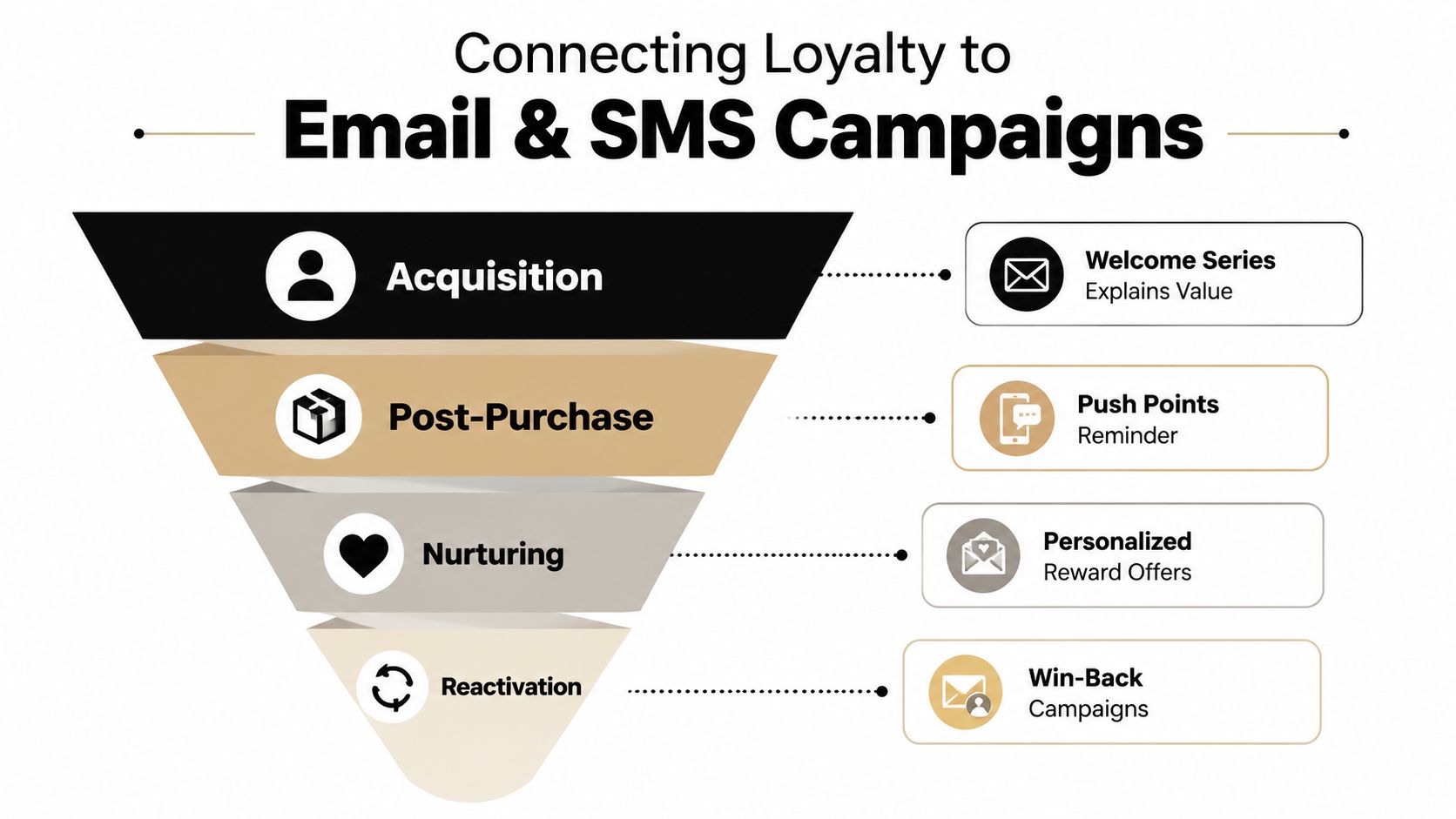
Win-back messaging should use the customer's actual position. Someone with unused points needs a different message from someone who has never joined. Expiring points, an available reward, or a missed tier threshold can replace a generic discount, provided the message is accurate and the offer doesn't erase the margin you're trying to protect.
Paid VIP members deserve their own communication layer. Use concierge access, early drops, members-only products, or SMS broadcasts for relevant launches. Sending every member the same message weakens the point of status.
The data handshakes are essential:
- Point balance: The ESP and SMS platform need the current balance, not a stale nightly export.
- Tier status: Segments should update when customers move up, down, or toward a threshold.
- Reward eligibility: Messages must suppress rewards that have already been used or expired.
- Purchase timing: Replenishment and win-back triggers should account for the customer's normal interval.
For practical campaign planning, review these winning email loyalty tactics alongside your existing lifecycle calendar. Loyalty personalization collapses when the message promises a benefit that checkout can't recognize. Connect the program to your SMS marketing strategy so customers can act on a reward without hunting through their account.
The KPIs That Separate Real Loyalty From Vanity Metrics
Enrollment is easy to report and difficult to interpret. A customer can join, collect points, and never purchase again. Track behavior and economics instead.
The central measures are repeat purchase rate, redemption rate, incremental revenue per member, tier progression speed, and repeat-purchase lift against a matched control group. The control matters because members may already be your strongest customers. Without it, you can mistake selection bias for program impact.
The redemption formula should use the program's actual accounting logic. A retail KPI guide defines redemption rate as total points spent divided by total points issued, with expired points included in the issued total. For lift, use:
Repeat Purchase Lift = member repeat rate − non-member repeat rate
The plan notes for this program specify a warning threshold of under 15% redemption, which can indicate that rewards feel unreachable, and above 60%, which can indicate that points are too easy to earn and margin is leaking. They also specify keeping point-balance liability below 8% of monthly revenue for a sustainable program. Treat these as operating guardrails, not universal laws, and investigate the customer and product mix behind every breach.
| KPI | Formula | Healthy Benchmark | Warning Sign |
|---|---|---|---|
| Repeat purchase rate | Repeat purchasers ÷ eligible customers | Rising versus baseline | Members behave like non-members |
| Redemption rate | Points spent ÷ points issued | Between the program's tested guardrails | Under 15% or above 60% |
| Repeat purchase lift | Member repeat rate − non-member repeat rate | Positive lift against matched control | No incremental difference |
| Point liability | Outstanding point value ÷ monthly revenue | Under 8% | Liability grows faster than contribution |
| Tier progression speed | Time to next tier | Progress matches the purchase cycle | Customers stall or jump too quickly |
| Incremental revenue per member | Incremental member revenue ÷ members | Positive after reward cost | Revenue is mostly subsidized |
Your cohort retention curve is the final judge. Plot members against a matched non-member cohort and watch when the second purchase happens, how frequently later orders arrive, and whether the curve improves after a mechanic changes. Use the broader e commerce performance metrics guide to keep loyalty reporting connected to store-level economics.
A Practical Roadmap to Launch Your Program
A controlled rollout beats a grand launch. Build the program in phases, assign ownership, and make every milestone measurable.
Phase one, audit and segment
Start with repeat-purchase data. Segment the top 20% of customers by revenue to identify who already demonstrates valuable behavior, then decide whether the program should deepen existing demand rather than chase net-new acquisition. The retention lead owns the analysis, finance validates contribution, and the milestone is a documented target segment with a baseline repeat rate.
Avoid launching to everyone before you know which customers and products create profitable repeat behavior.
Phase two, design and build
Choose points, tiers, paid access, or a value-based model according to margin and purchase cycle. Configure the earn rules, redemption catalog, and status benefits, then stress-test the cost of every reward, including likely redemption and expiration. The retention lead and developer build the experience. Finance signs off on liability.
The milestone is a working program that can explain its value in one customer-facing sentence.
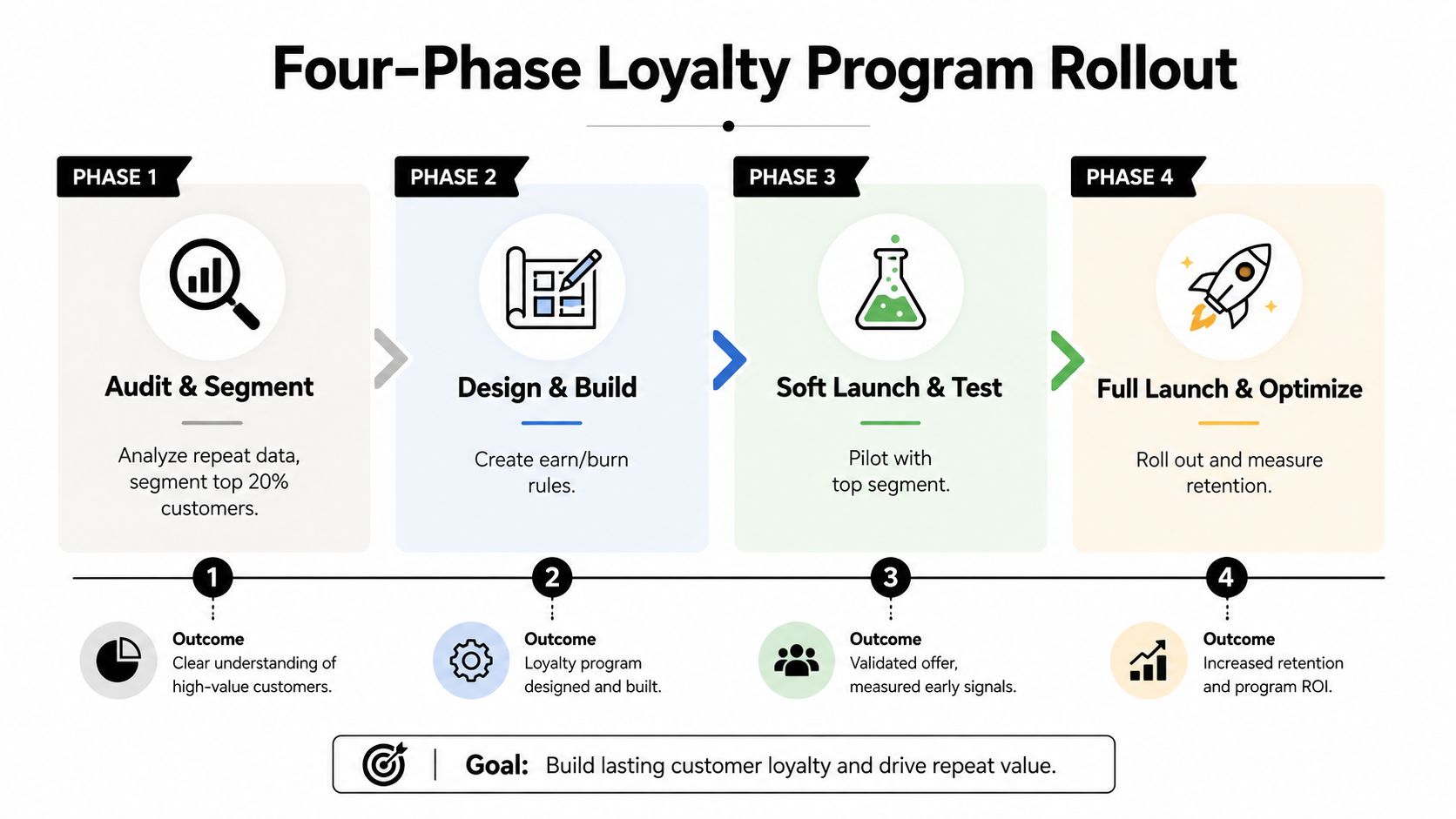
Phase three, integrate and test
Connect the loyalty platform to the ESP, SMS tool, store, and checkout. Point balance, tier status, reward eligibility, and purchase events must trigger welcome, replenishment, win-back, and VIP access flows. The developer owns data integrity, while the retention lead tests message logic and suppression rules.
Pilot with a single cohort for 60 days before scaling. Keep the cohort definition fixed so the comparison remains useful.
Phase four, launch and optimize
Scale only after the pilot shows a positive behavioral signal after reward cost. Review the retention lead's cohort report with finance, then adjust earning ratios, reward timing, and tier thresholds. Legal should review point expiration language before customers enroll.
Watch for too many tiers, unclear exclusions, broken checkout redemption, and messages that reference stale balances. Use this video as a practical implementation reference for the rollout sequence:
The One Question Every Loyalty Program Should Answer
A loyalty program earns its operating cost only when it changes repeat behavior. Enrollment counts, points issued, and email open rates can fill a quarterly review, but none proves that the program created profitable revenue.
Ask one question: Does a member make a second purchase sooner, at a higher average order value, and at a lower blended acquisition cost than a comparable non-member?
The answer requires more than a dashboard total. Instrument cohort retention curves, define a matched control, and track the timing and margin of subsequent orders. Separate customers who joined before purchasing from customers who enrolled after demonstrating repeat behavior. Otherwise, the program may receive credit for customers who were already loyal.
Kill mechanics that only subsidize discounts. If a birthday bonus creates activity but no later purchase, reduce it or remove it. If a tier threshold changes order timing, keep testing the benefit. If free shipping creates more profitable repeat orders than a percentage discount, shift the reward catalog toward shipping.
The best loyalty feature is the one that makes the next profitable purchase more likely.
Design backward from that question. Every point, tier, reward, email, and SMS message becomes a test of retention rather than a feature added for appearance.
Ecommerce Boost helps online retailers connect lifecycle email and SMS campaigns to repeat purchases, customer lifetime value, and retention reporting. Visit Ecommerce Boost to review its retention services and plan a loyalty program that measures incremental behavior instead of enrollment alone.


