



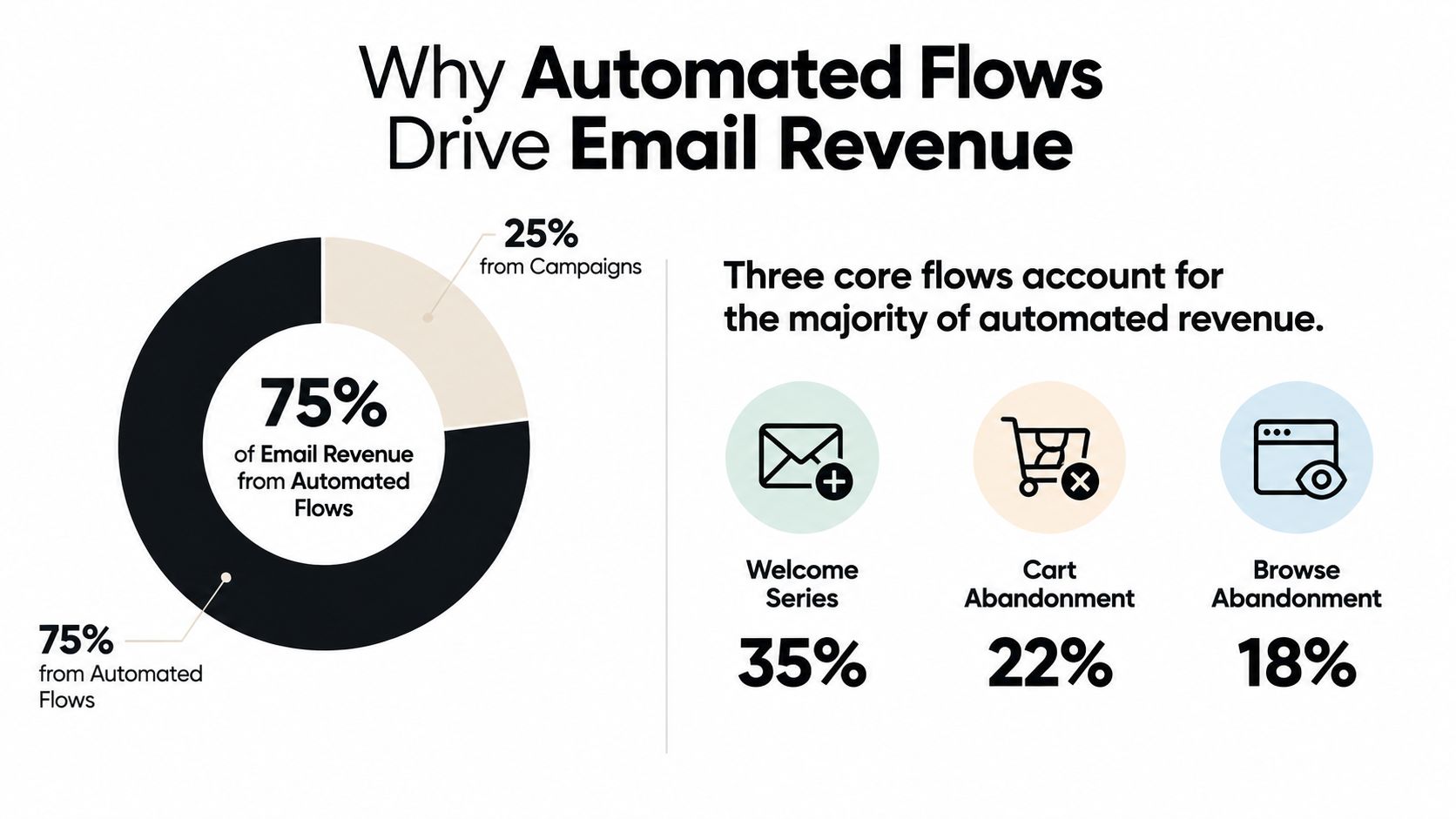
Automated flows can generate 41% of total email revenue from just 5.3% of sends, with revenue per recipient almost 18 times higher than campaigns, according to Klaviyo benchmark data summarized by Darkroom. That concentration changes how ecommerce teams should approach lifecycle marketing. The priority isn't building an impressive catalog of sequences. It's making the few behavior-triggered flows that matter most produce more revenue per recipient.
For most stores, those flows are welcome, abandonment, and post-purchase or browse recovery, depending on the customer journey and product category. Cart recovery deserves special attention because online cart abandonment remains around 70.22% to 71.72%, while the strongest automated flows capture high-intent moments that one-time campaigns can't recreate (cart abandonment benchmarks). The practical strategy is simple: tighten the top three before adding another branch.
Why Ecommerce Email Flows Outperform Every Other Channel
The strongest case for ecommerce email flows is revenue concentration. Automated messages can represent only 2% of total email volume while driving about 30% to 37% of email-generated sales, according to the ecommerce email marketing statistics roundup. That isn't because flows send more often. They send when a customer has created a clear intent signal, such as subscribing, viewing a product, adding an item to a cart, or completing a purchase.
A campaign asks, “Who should receive this promotion today?” A flow asks, “What did this person just do, and what message helps them take the next step?” That distinction gives lifecycle automation a structural advantage. The audience keeps growing as new shoppers enter the journey, while the sequence continues operating without a new media purchase or a manual send.
Paid social and search can generate valuable demand, but each additional conversion generally requires additional ad spend. An automated flow uses an owned audience and responds to behavior already recorded in the customer journey. The economics won't be identical for every store, but the operating principle is consistent: intent-based messages usually deserve optimization before broad promotional volume.
Why a short stack beats a long checklist
A long flow library can create the illusion of sophistication. In practice, every added sequence introduces new suppression rules, competing triggers, creative requirements, and reporting problems. A weak welcome series still consumes attention if the team keeps commissioning a birthday flow instead of fixing its conversion path.
Klaviyo's benchmark data shows flows generating nearly 41% of email revenue from 5.3% of sends, with average revenue per recipient almost 18 times higher than campaigns (Darkroom's benchmark summary). The implication is more useful than the headline: concentrate optimization where intent is strongest.
Practical rule: Before launching another flow, check whether your welcome, cart recovery, and browse or post-purchase logic have clean triggers, relevant segmentation, and tested offers.
Teams that need a broader explanation of trigger-based automation can use Up North Media's marketing automation guide as a useful strategic reference. For a complementary view of email's role as an owned channel, review why email marketing remains important for ecommerce.
The Core Flow Types and What Each One Actually Does
Each flow should exist because a specific behavior creates a specific job. A welcome series isn't a softer cart reminder, and a post-purchase sequence shouldn't behave like an acquisition campaign. The trigger determines the context, and the context determines the conversion event.
| Flow Type | Trigger | Primary Job | Typical Conversion Window |
|---|---|---|---|
| Welcome | New subscriber or account signup | Establish trust and generate a first purchase | Signup through early consideration |
| Browse abandonment | Product or category viewed without cart activity | Re-engage a high-intent visitor | Shortly after browsing |
| Cart abandonment | Item added without completed checkout | Recover the interrupted purchase | The active consideration window |
| Post-purchase | Purchase completed or order delivered | Reduce uncertainty, earn reviews, and encourage repeat purchase | Confirmation through the next buying cycle |
| Win-back | Previous buyer becomes inactive | Reopen the relationship before churn | Before the customer becomes fully lapsed |
| Replenishment | Expected product usage or reorder interval | Prompt a repeat purchase | Around the product's consumption cycle |
| Sunset | Sustained disengagement | Protect list quality and reduce irrelevant sends | After repeated inactivity |
The welcome flow earns permission
The welcome series introduces the brand, sets expectations, explains what makes the product useful, and captures zero-party data, meaning preferences the subscriber intentionally shares. A skincare store might ask about skin concerns. A food brand might collect dietary preferences. That information can shape later recommendations.
The first message should make the signup feel complete, not immediately turn into a discount billboard. Later emails can introduce bestsellers, proof, education, and an incentive when the subscriber hasn't purchased.
Browse and cart flows handle different levels of intent
Browse abandonment targets someone who viewed a product but didn't add it to a cart. The sequence should recreate the product context, answer an objection, or show a relevant alternative. It needs restraint because a viewed product isn't necessarily a buying decision.
Cart abandonment is closer to the transaction. The shopper has selected an item, so the message should restore the path to checkout with product imagery, a clear return link, and friction-reducing information. Discounts should be gated by cart value, margin, or observed exit behavior rather than applied automatically.
Post-purchase and win-back protect future revenue
Post-purchase messaging starts with reassurance, usage guidance, shipping context, or care instructions. A review request and category-based cross-sell can follow after the customer has had time to experience the product. Its primary purpose is retention, not immediate acquisition.
Win-back addresses a different problem. The customer already knows the brand but hasn't returned within the store's normal buying cycle. The message can feature what changed, recommend a relevant product, or ask whether the customer still wants communication. Sunset and replenishment are situational additions, not mandatory foundations for every catalog.
For a deeper operational framework, see email automation workflows for ecommerce.
Benchmarks That Separate Average Flows From Top Performers
Benchmarks are useful only when the comparison is fair. A post-purchase email can show strong engagement because customers already bought, while a cart message competes for an unfinished transaction. Judging both by the same conversion target leads teams to optimize the wrong sequence.
Independent 2026 ecommerce benchmarks place common cart-abandonment flows around 40% to 50% open rates, 6% to 12% click rates, 5% to 10% conversion rates, and roughly $3.00 to $8.00 revenue per recipient (BS&Co ecommerce benchmarks). Welcome flows typically generate about $1.50 to $4.00 per recipient, while browse-abandonment and win-back flows are generally lower.
| Flow Type | Open Rate (Avg / Top) | Click Rate (Avg / Top) | Conversion Rate (Avg / Top) | RPR (Avg / Top) |
|---|---|---|---|---|
| Cart abandonment | 40% to 50% / Strong upper range | 6% to 12% / Strong upper range | 5% to 10% / Strong upper range | $3.00 to $8.00 / Higher for leading flows |
| Welcome | Not consistently comparable / Higher-performing range varies | Not consistently comparable / Higher-performing range varies | Not consistently comparable / Higher-performing range varies | $1.50 to $4.00 / Higher for leading flows |
| Browse abandonment | Typically below cart recovery / Higher by account | Typically below cart recovery / Higher by account | Typically below cart recovery / Higher by account | Lower than welcome in many accounts / Higher by account |
| Win-back | Typically lower because of inactivity / Higher by account | Typically lower because of inactivity / Higher by account | Typically lower because of inactivity / Higher by account | Typically low / Higher by account |
| Post-purchase | Often strong engagement / Higher by account | Depends on message purpose / Higher by account | Usually lower for direct purchase / Higher by account | Retention-focused rather than acquisition-focused |
Klaviyo benchmark data summarized by Shno's lifecycle email statistics reports $3.65 average cart-abandonment RPR, $28.89 for the top 10%, and a 3.33% average placed-order rate. The same summary says high-AOV brands can exceed $14.14 RPR, so a store shouldn't judge a cart flow without accounting for product economics.
Across automated flows, the average click-through rate is 4.67% and average conversion rate is 1.42%, while the top 10% reach 12.21% CTR and 4.93% conversion (Shno's email automation benchmarks). Use revenue per recipient as the first commercial calibration, then use clicks and conversion to diagnose the reason behind the result. Email marketing ROI analysis can help teams connect those flow metrics to broader channel economics.
Segmentation and Timing Strategies That Lift Revenue
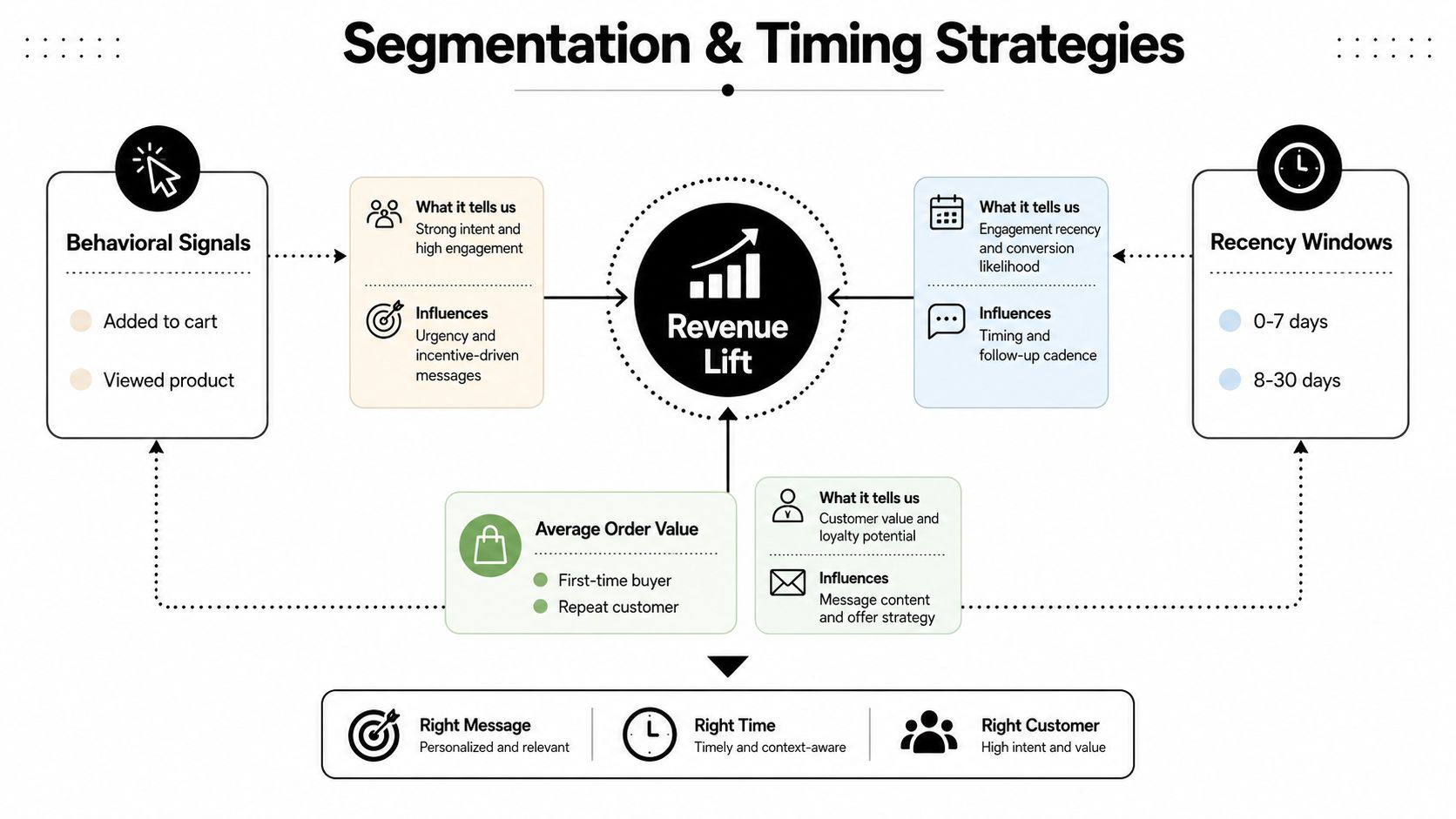
A flow becomes useful when it reacts to meaningful differences between customers. Start with behavioral signals, then add recency and average order value. A single message for every subscriber usually forces the highest-value customers and the most price-sensitive prospects into the same treatment.
Build the segments before writing the emails
Separate first-time subscribers from repeat customers inside the welcome experience. New prospects need brand context and proof. Repeat customers may need product discovery, loyalty recognition, or a complementary recommendation instead.
Cart abandoners should be split by cart value. A low-value cart may respond to free shipping or reassurance, while a higher-value cart can justify a more carefully controlled offer. Post-purchase segments should use product category, because a customer who bought a cleanser shouldn't receive the same cross-sell as someone who bought a supplement or a replacement part.
Suppress recent buyers from win-back sequences. A customer who purchased yesterday isn't lapsed just because they haven't opened the latest campaign.
Match timing to the behavior
Use the event timestamp as your starting point, then adjust from observed session behavior.
- Welcome timing: Delay the first welcome email by 30 minutes when the signup experience benefits from a calmer handoff or when immediate delivery creates engagement problems.
- Cart recovery: Send the second recovery email within 1 to 3 hours when the store's data shows rapid decision-making. Later messages can address objections rather than repeat the same reminder.
- Browse abandonment: Test a window between 4 and 24 hours, depending on how quickly shoppers typically return to the site.
- Offer ladders: For AOV tiers under $50, between $50 and $150, and above $150, vary the offer type, creative density, and discount protection. The exact incentive should follow margin and purchase behavior, not a universal rule.
These segmentation rules must exist in Klaviyo, Omnisend, or the relevant ESP before launch. Use profile properties, events, conditional splits, and custom fields so the logic runs automatically. Retrofitting segments after data has accumulated usually means earlier sends already delivered the wrong experience.
A practical framework for structuring those audiences is available in email segmentation best practices. The most valuable segment isn't always the most obvious demographic group. It's often the behavioral group with a distinct next action.
Implementation Checklist Before You Hit Publish
A well-written flow can still fail because the platform doesn't receive the right event, the product feed is incomplete, or the suppression rules overlap. Treat implementation as a launch gate, not a technical detail to tidy up afterward.
Platform and data setup
Connect the store catalog to Klaviyo, Omnisend, or the chosen ESP, then verify the events that power the lifecycle logic:
- Event tracking: Test Add to Cart, Checkout Started, and Purchase events with live behavior.
- Profile properties: Map AOV, product category, purchase count, and customer status.
- Suppression rules: Exclude unsubscribed profiles, recent purchasers, and contacts already completing the target action.
- Product blocks: Confirm that dynamic product recommendations display the correct image, title, price, and destination URL.
The flow trigger should reflect the actual customer action. A cart flow triggered by a page view will produce irrelevant reminders, while a post-purchase flow without purchase confirmation can create a damaging customer-service problem.
Deliverability and creative
Authenticate the sending domain with SPF, DKIM, and DMARC. For stores sending more than 100,000 emails per month, evaluate whether a dedicated sending IP fits the program's volume and reputation management needs. Prune inactive profiles older than 90 days before a major launch when the list contains stale engagement.
Keep the creative mobile-first. Use a template under 600 pixels wide, compress the hero image below 200 KB, add alt text to every image, and prepare product feed blocks before the first test. These constraints keep the message readable and reduce dependence on images loading perfectly.
QA that catches expensive mistakes
Send live test purchases through the full journey. Preview each email in Gmail, Apple Mail, and Outlook, then click every link in sequence. Check currency, inventory state, discount eligibility, unsubscribe behavior, and the condition that stops a message after purchase.
Launch standard: Don't approve a flow because the email looks right in the editor. Approve it only after the event, branch, suppression, rendering, and destination path all work in a real test.
Sample Sequences for Cart Recovery and Welcome Flows
The two sequences below use different persuasion logic. Cart recovery starts with an existing product decision and removes friction. Welcome messaging earns the first purchase by building context before escalating the offer.
| Email # | Cart Recovery Timing & Purpose | Welcome Flow Timing & Purpose |
|---|---|---|
| 1 | 1 to 3 hours: Show the product and use one CTA back to the cart | Immediately: Confirm signup and set expectations |
| 2 | 24 hours: Add social proof, a review snippet, or objection handling | Day 2: Share the brand story or a founder note |
| 3 | 48 to 72 hours: Introduce a discount only when exit-intent or cart-value logic supports it | Day 4: Feature a bestseller with a review |
| 4 | 96 hours: Add SMS or push when integrated and permissioned | Day 7: Present the first-purchase incentive |
| 5 | Not required for every store | Day 10: Introduce loyalty or referrals |
Cart recovery sequence
Email one should use a subject formula such as “Still considering {{ product }}?” with preview text like “Your selected items are waiting in your cart.” Keep the body focused on product imagery, availability context, and a single return-to-cart button.
Email two can use “A closer look at {{ product }}” with “See how customers use it.” Add a review excerpt, product benefit, sizing information, or returns reassurance. Don't repeat the first email's copy with a different subject line.
Email three should use “Your cart is still saved” with “A limited incentive may be available for this order.” Gate the offer by exit-intent data or a cart-value threshold. If the shopper doesn't qualify, show value and service information rather than inventing urgency. A final SMS or push at 96 hours can support the email sequence when the customer has explicitly opted into that channel.
Welcome sequence
Email one can use “Welcome to {{ brand }}” with “You're subscribed. Here's what you can expect.” Email two might use “Why we made {{ brand }}” with “The product story behind the store.” Email three can use “Meet the customer favorite” with “See why shoppers choose {{ bestseller }}.”
Email four introduces the incentive with “Your first order is ready” and preview text that explains the benefit clearly. Email five can use “More ways to stay connected” to present loyalty or referrals.
The escalation logic matters. Start with brand value and product proof, then offer the first incentive only after earlier emails fail to produce a purchase. Increase discount depth only when the subscriber remains unconverted and the margin model supports it. Brands commonly over-discount in the first welcome email, teaching customers to delay instead of rewarding genuine purchase intent.
Why Adding More Flows Usually Loses to Tightening the Top Three
More flows don't automatically create more revenue. They create more opportunities for timing conflicts, duplicate messages, broken suppression rules, and irrelevant recommendations. The revenue concentration data points to a better operating model: optimize the few sequences that already capture the strongest intent.
Independent 2026 research found that automated flows generated 41% of email-driven revenue from 5.3% of send volume, while welcome, abandoned cart, and browse abandonment accounted for 87% of automated orders (Monocle's ecommerce lifecycle trends). That doesn't mean every store should ignore post-purchase or win-back. It means the team should prove that a new sequence can compete with an existing high-yield flow before diverting resources.
| Flow Type | Avg Revenue Share | Top-Decile Revenue Share |
|---|---|---|
| Welcome | Concentrated within the core automated share | Stronger when signup intent and offer timing are aligned |
| Cart abandonment | Often among the highest commercial contributors | Can materially exceed average RPR when intent and AOV are strong |
| Browse abandonment | High order contribution in the cited research | Improves when recommendations and timing are precise |
| Post-purchase | Retention-oriented contribution | Stronger when measured through repeat purchase and LTV |
| Win-back | Usually a smaller direct-revenue contributor | Valuable for selected lapsed segments |
| Sunset, review, birthday, and other additions | Situational | Depends on audience relevance and operating quality |
Consider two operating models. One account runs 14 mediocre flows, each with overlapping triggers and inconsistent exclusions. Another runs 6 carefully maintained flows, with clean event logic, differentiated audiences, and revenue-per-recipient reporting. The second account may produce more useful automation because each message has a clearer job and fewer chances to interrupt another lifecycle moment.
Before commissioning a new sequence, ask: Will this flow beat our current browse-abandonment flow on revenue per recipient? If the answer isn't yes, first improve the existing trigger, offer, recommendation block, or suppression logic.
Testing and Optimization Playbook for Lifecycle Revenue
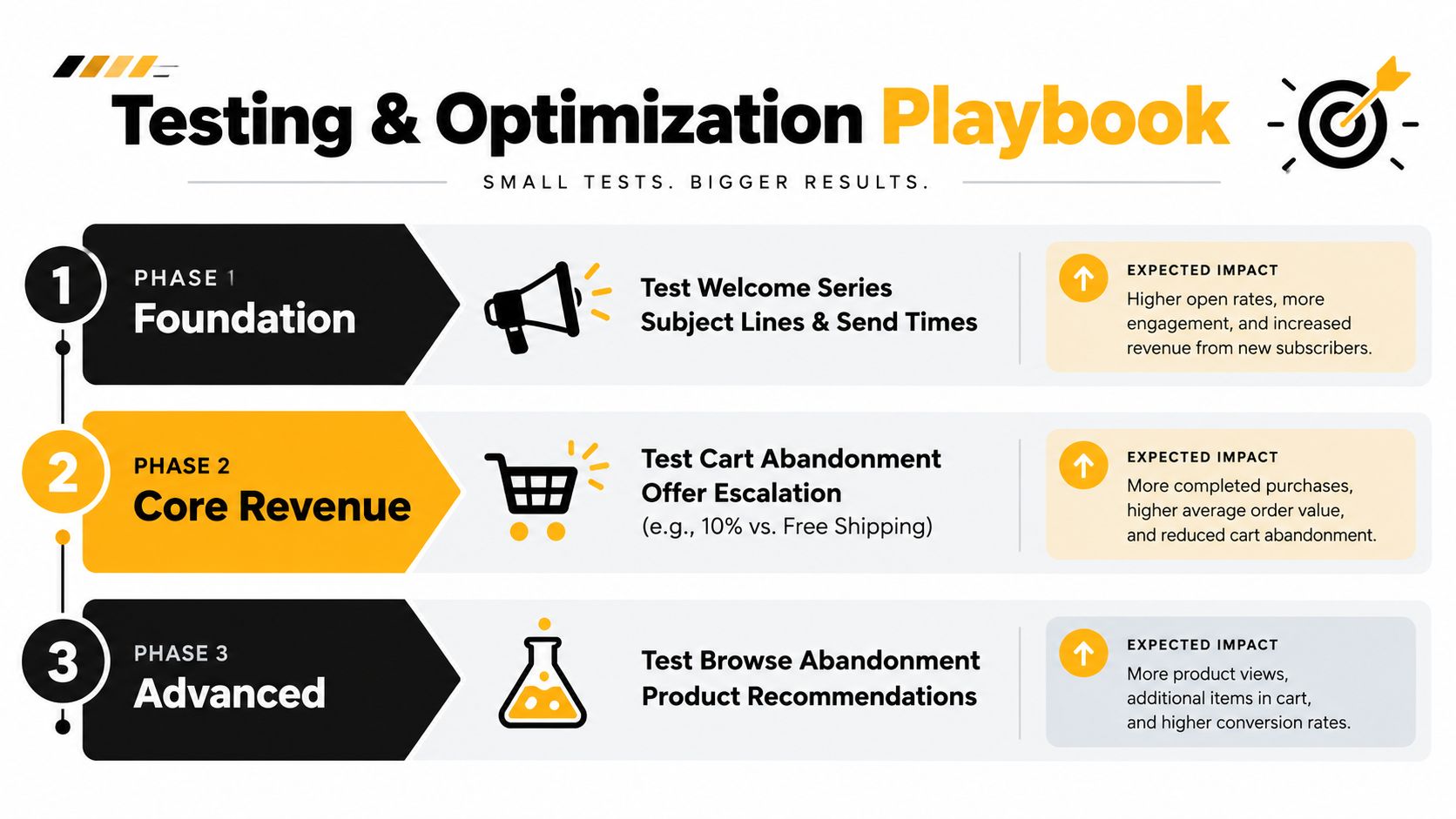
Testing should follow expected commercial impact, not novelty. Start with the flow that has the clearest intent and the largest concentration of revenue, then move outward only after the basics work.
A prioritized testing order
- Welcome series: Test subject lines and send times first. The question is whether the subscriber opens and moves toward a first purchase without requiring an early discount.
- Cart abandonment: Test offer escalation, such as a discount against free shipping, while protecting customers who would have purchased without an incentive.
- Post-purchase: Test creative variants, product education, review requests, and cross-sell placement. Judge this flow by retention behavior, not just immediate sales.
- Browse abandonment: Test recommendation logic and the timing window after the core flows have stable tracking.
Use a 14-day minimum test window and a 95% confidence threshold before declaring a winner, as specified in the testing framework for this program. If volume is limited, treat early results as directional and keep the test running rather than making a decision from a handful of conversions.
The reporting rhythm
Watch revenue per recipient first after launch because it combines audience quality and commercial performance in one measure. Review flow-level results weekly, compare new and returning customer cohorts monthly, and audit suppression logic quarterly.
Open rate can help identify delivery or subject-line problems, but it shouldn't decide which flow gets more resources. Click rate, conversion rate, RPR, average order value, margin, and repeat purchase behavior provide a stronger operating picture.
Refresh the sequences before creative fatigue and product changes make the logic stale. Check links, inventory blocks, offers, audience definitions, and stop conditions on a recurring schedule rather than waiting for a six-month performance decline.
Ecommerce Boost offers lifecycle strategy, segmentation, automated welcome, browse, cart recovery, post-purchase, and win-back flows for online retailers. If your top three automations aren't producing enough revenue per recipient, visit Ecommerce Boost to review a practical path for improving triggers, creative, testing, and reporting.


