




A 2023 customer win-back benchmark found that 26% of past customers returned after win-back campaigns, with most participating companies reacquiring between 20% and 35% of former customers (Customer Win-Back Benchmark Study 2023). That changes the question from “Should we send a ‘We miss you' email?” to “Why are we treating a core revenue pool like a one-off promotion?”
The answer to how to win back customers isn't a bigger discount sent to everyone. Strong programs identify when a customer became inactive, what they bought, how valuable they were, and what reason might bring them back. Then they escalate the offer only when earlier, margin-friendly messages fail.
Why Win-Back Programs Drive Predictable Revenue
Win-back revenue becomes predictable when reactivation is built into the customer lifecycle rather than attached to a seasonal calendar. An automated flow can respond to inactivity, purchase history, browsing behavior, and engagement without waiting for a marketer to remember that a dormant segment exists.
The benchmark above makes the opportunity substantial. A return rate of 26% on average means lapsed customers aren't merely a low-probability audience. They already know the brand, have completed the initial trust-building step, and may still have a product need. The commercial logic is straightforward: recovering repeat revenue from an existing customer generally requires less effort than creating demand among people who have never purchased.
| Metric | New Customer Acquisition | Win-Back Reactivation |
|---|---|---|
| Audience relationship | No purchase history | Previous purchase and brand experience |
| Primary challenge | Build awareness and trust | Restore relevance and motivation |
| Message foundation | Broad targeting and product promise | Past behavior, product fit, and timing |
| Margin risk | Acquisition costs sit outside the offer | Discounts can reduce profit on an already-known buyer |
| Operating model | Campaign and channel dependent | Triggered lifecycle flow |
That last row matters. Win-back doesn't become efficient because the audience has purchased before. A generic blast can still waste revenue, train customers to wait for promotions, and keep unresponsive contacts on the list. It also hides which customers would have returned without an incentive.
Practical rule: Treat every win-back offer as a cost decision, not a goodwill gesture.
The hidden cost of ignoring lapsed buyers appears in several places:
- List decay: Dormant contacts reduce the useful share of your database and can weaken engagement signals.
- Cold-audience dependence: Paid teams keep spending to find new shoppers while known buyers sit untouched.
- Lower lifetime value: A customer who would have made another purchase receives no timely reason to do so.
- Poor learning: One-off campaigns don't reveal which inactivity windows, products, or offers produce incremental revenue.
A useful primer on the financial logic is this explainer on customer lifetime value, especially when deciding how much margin a reactivation attempt can reasonably consume. Teams building a broader retention system can also use this retention marketing overview to connect win-back with post-purchase, replenishment, and loyalty activity.
Segmenting Lapsed Customers by Recency and Value
Segmentation should shape the message, creative, and offer before any campaign is built. Start with one generic email and divide the audience later, and you usually lose control over relevance and margin. Blanket discounts can also pay customers who would have returned without an incentive.
Recency is the first filter. Group customers by inactivity windows such as 60, 90, 120, and 180+ days, then adjust those windows to the product's normal replenishment cycle. A skincare customer and a furniture buyer should not enter the same program because both have stopped purchasing.
Messages sent 30 to 45 days after the last purchase can convert about 2.3 times better than messages sent 90 or more days afterward, according to ecommerce win-back timing guidance. Reach customers while the prior purchase remains relevant, then reserve stronger recovery tactics for older inactivity cohorts.
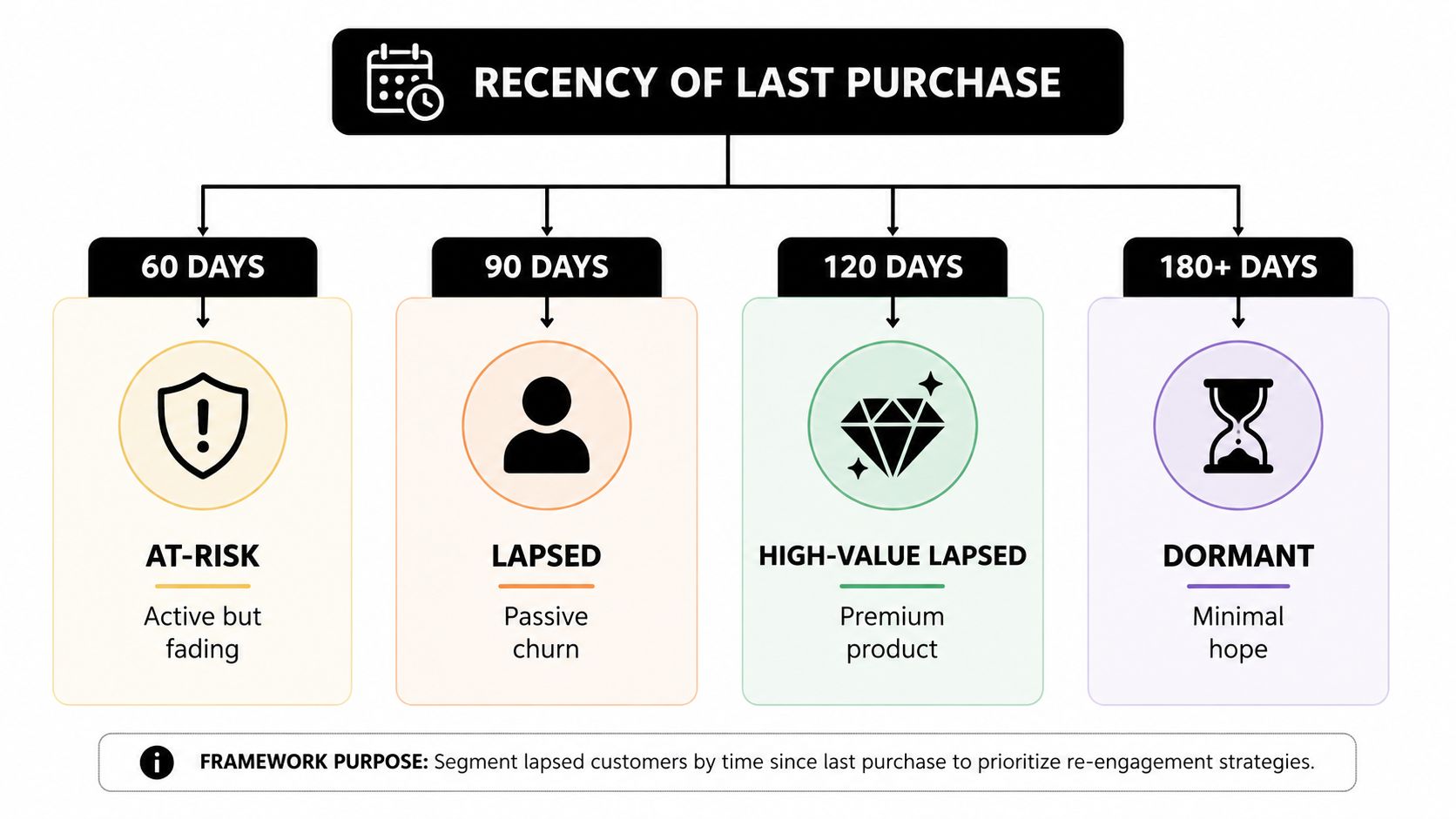
Build a recency and value matrix
Add purchase history to each inactivity group. Track at least these fields:
- Average order value: High-AOV customers may justify premium creative, personal outreach, or a shipping benefit before a price reduction.
- Category affinity: A running-shoe buyer needs a different return reason from a supplements buyer.
- Lifetime order count: Several purchases suggest established product fit. A single-purchase customer may need education, reassurance, or discovery content.
- Margin profile: Revenue alone does not define customer value when returns and discounts consume contribution margin.
Plot recency on one axis and customer value on the other. Recently inactive, high-value buyers warrant the most thoughtful treatment because a relevant message may recover demand without a broad discount. Long-dormant, low-value customers may belong in a lighter sequence, a preference campaign, or a sunset path.
Use an RFM customer segmentation framework to make prioritization more consistent, but tie the resulting groups to contribution margin and likely incremental revenue. A score should guide the decision, not replace it.
Protect the offer pool
Separate customers who repeatedly return products, purchase only during promotions, or bought gifts with little evidence of personal product interest. A gift purchaser may not need the product again. A promotion-only buyer may accept another discount while still failing to become a profitable repeat customer.
Keep engaged and silent customers apart. A recent click signals curiosity and supports a relevant follow-up. No opens, clicks, or browsing after the last purchase points to a deliverability, relevance, or product-fit issue. Those customers should not receive identical pressure or the same offer.
Building a Multi-Stage Win-Back Flow
A multi-stage flow protects margin by matching pressure to customer intent. One email cannot reveal whether a customer needs product education, a reminder, or a stronger reason to buy. A sequence creates those signals and raises the offer only when behavior shows that softer messages did not work.
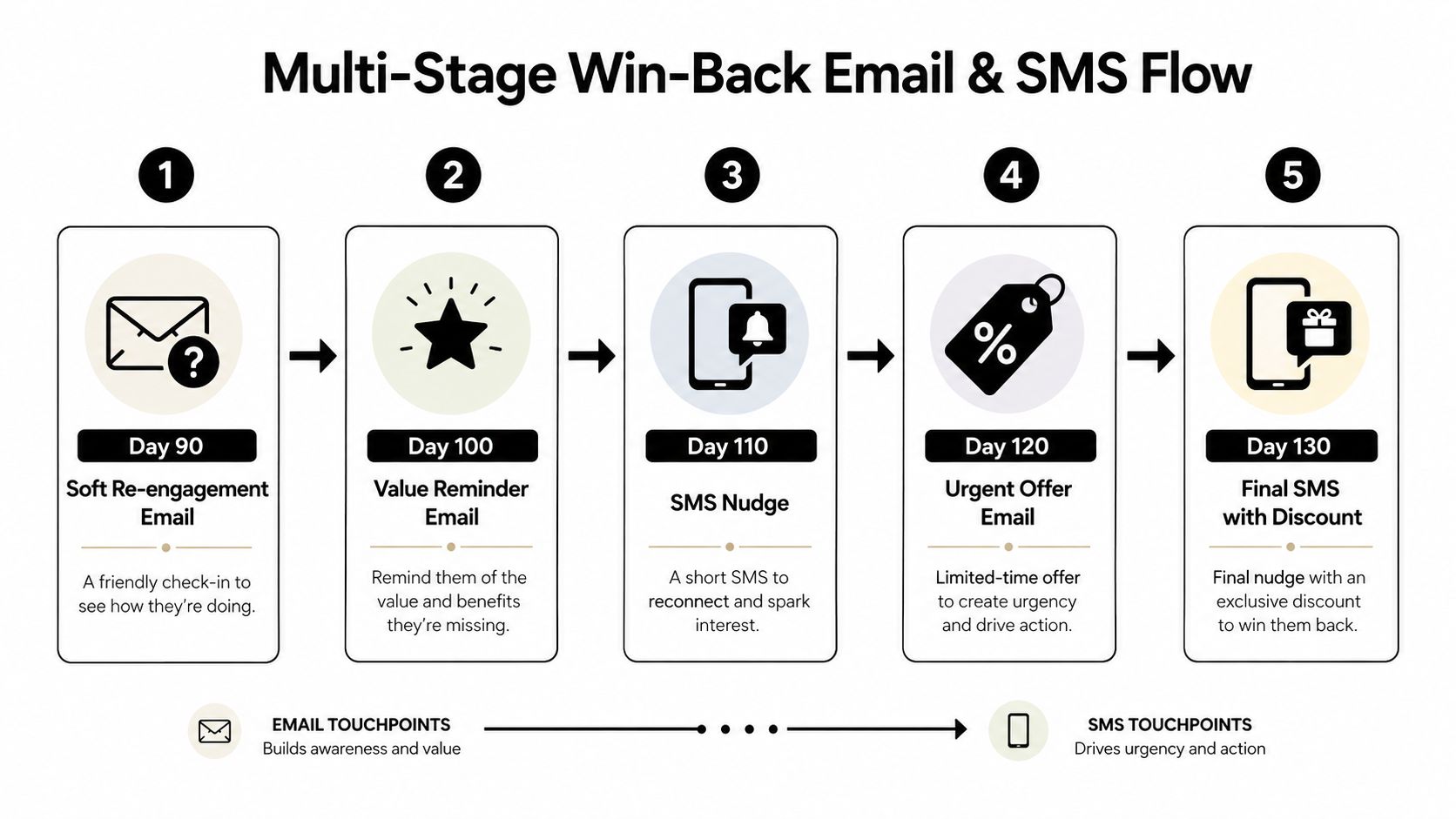
Use five stages, with timing adjusted to the product's normal repurchase cycle:
- Day 90, soft re-engagement: Confirm that the customer still wants updates, feature a relevant category, or introduce a new product. Keep the first message free of discounts.
- Day 95, relevance reminder: Show new arrivals, useful reviews, or products related to the previous purchase. Split openers from non-engagers. An open without a purchase indicates a different follow-up opportunity than no interaction at all.
- Day 100, value-add message: Provide product education, suggest a complementary bundle, remind the customer about warranty coverage, or offer threshold-based shipping. Give the customer a practical reason to return before reducing price.
- Day 107, first monetary incentive: Present a controlled offer only to customers who have not converted. Set the incentive according to customer value, contribution margin, and category economics.
- Day 114, final urgency: State the expiry clearly, give the customer one action, and explain what happens next. Suppress the contact after this attempt unless they re-engage.
This escalation logic prevents an early discount from subsidizing a customer who was already ready to purchase. It also makes the flow easier to optimize. Clickers can receive product-specific content, openers can receive more education, and purchasers should exit immediately.
Add SMS with restraint
SMS should enter when urgency or a meaningful offer justifies interrupting the customer. For high-value segments, place it near the incentive stage, particularly after an email click or relevant product browse. Sending texts to every dormant contact adds pressure without improving the underlying relevance problem.
Your email marketing flows for ecommerce need explicit exit rules. Remove customers after purchase, unsubscribe, a clear negative preference signal, or completion of the final attempt. Without an endpoint, the flow creates fatigue, increases complaints, and competes with messages intended for active customers.
Designing Offers That Reactivate Without Killing Margin
The default “20% off for everyone” strategy looks simple because it avoids decision-making. It also teaches customers that waiting is rational. If the product, shipping economics, and customer history don't require a price cut, the discount transfers value from your margin to a buyer who may already have returned.
Attentive shopper research identifies good deals and promotions at 52%, product quality at 45%, free or fast shipping at 38%, and fair pricing at 38% among reasons customers return (Attentive-related shopper research summary). The implication isn't that every customer needs a promotion. It's that value can take several forms, and your offer should answer the segment's likely objection.
| Customer Segment | Offer Type | Margin Impact | Best For |
|---|---|---|---|
| Recent, high-value customer | Early access or premium product preview | Usually low direct cost | Brands with new drops or limited releases |
| High-AOV customer with shipping friction | Free shipping threshold | Controlled if threshold protects basket economics | Bulky products or multi-item purchases |
| Category-specific buyer | Complementary bundle | Can improve unit economics and move related stock | Beauty, wellness, food, and accessories |
| Low-engagement customer | Product education and comparison content | Minimal direct cost | Products requiring explanation or confidence |
| Price-sensitive repeat buyer | Limited, segment-specific discount | Direct margin reduction | Customers with a proven promotion response |
| Deeply dormant customer | Final controlled incentive or preference request | Variable, potentially high | Last attempt before suppression |
Escalate value before price
Start with a product reason. Show what changed, what complements the previous purchase, or how the customer can get more utility from something they already own. A bundle can make the purchase feel more useful without discounting every item. A free-shipping threshold can encourage a larger basket while preserving the base product price.
Reserve a hard discount for the later stage, and cap it by segment. Never let the flow stack a win-back code with sitewide promotions, loyalty credits, and free shipping unless finance has approved the combined economics. Measure contribution margin after returns, fulfillment, and incentive cost, not just gross sales.
The strongest offer isn't the largest offer. It's the smallest benefit that answers the customer's reason to return.
Product education deserves more attention in low-engagement cohorts. If a buyer doesn't understand which refill, size, or companion item fits their needs, another code won't solve the problem. Explain usage, compare variants, answer objections, and make the next purchase easier to choose.
Writing Win-Back Emails and SMS That Convert
Win-back copy should acknowledge the existing relationship without sounding wounded or generic. “We miss you” can work as a supporting idea, but it can't carry the entire message. The customer needs a specific reason to care now.
Use a different job for each stage:
- Curiosity opener: Ask a question tied to the past purchase. “Still using your [product]?” or “Looking for a lighter option for [category]?” The email should invite a decision, not force a sale.
- Value anchor: Explain what's new, improved, or newly relevant. Mention a related product, a guide, or a better way to use the item they bought.
- Social proof: Put reviews, community activity, or product evidence near the decision point. Choose proof connected to the customer's category, not a random bestseller.
- Urgency closer: State the offer, deadline, and action clearly. Don't bury the expiration in a footer.
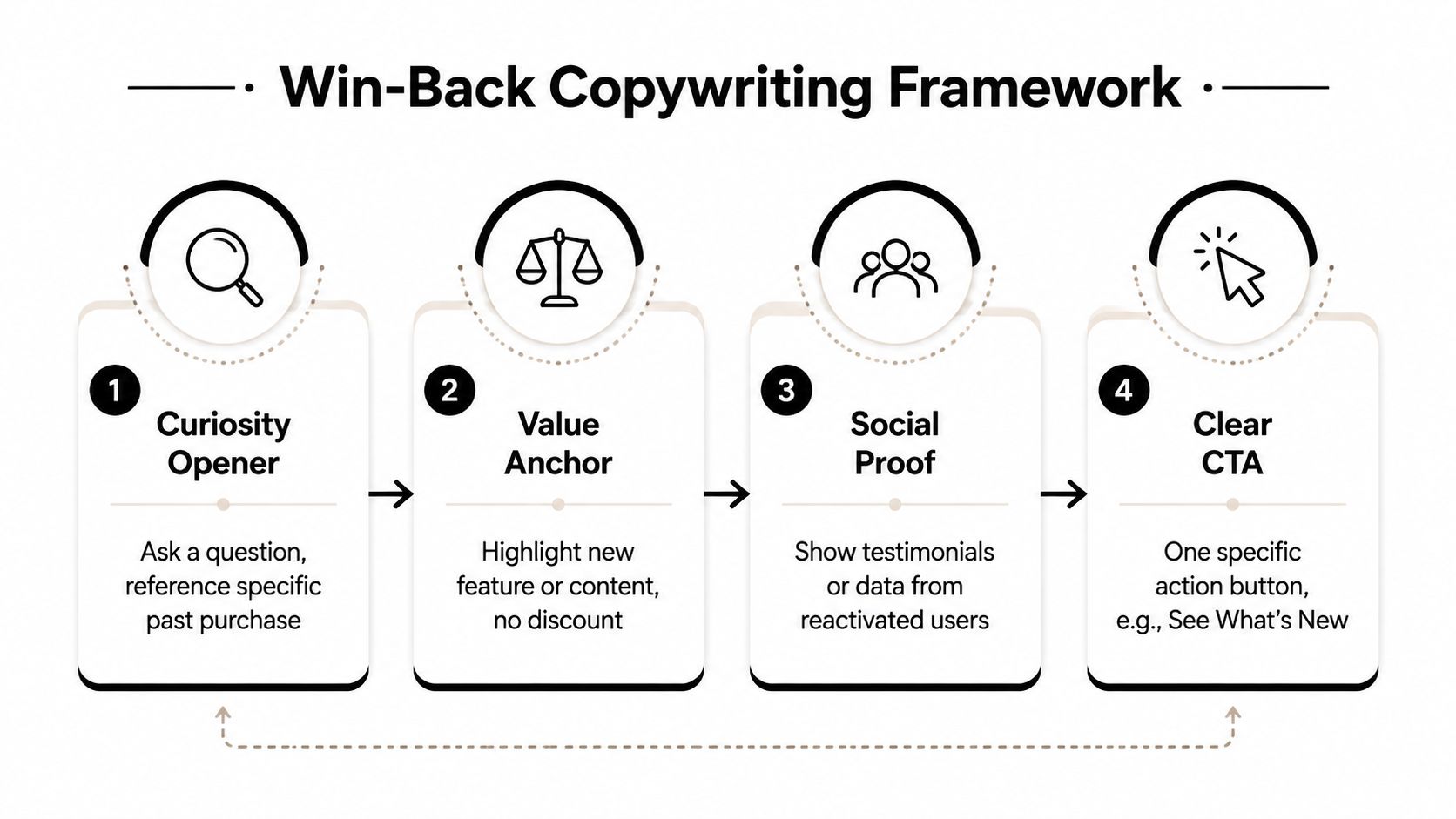
Personalize the reason, not just the greeting
A first name is table stakes. Useful personalization references the product purchased, the category browsed, the likely replenishment need, or the customer's previous order pattern. For a high-value customer, use exclusivity language such as “Your early access starts today.” For a promotion-driven segment, be direct about savings and redemption terms.
Keep the email focused on one action. “Shop new arrivals,” “Choose your refill,” and “Use your private offer” are stronger than a collection of competing buttons. Remove friction from the destination page, preselect the relevant category where possible, and preserve the customer's context from the message.
SMS needs even tighter editing. A practical format is:
Brand: [Name], your [product or category] is back. Your private offer ends [date]. Shop: [short link]. Reply STOP to opt out.
For a value-led text:
Brand: New [category] options are available for your previous purchase. See what fits: [short link]. Reply STOP to opt out.
Use your SMS marketing strategy to define consent, suppression, and channel priority before adding text messages to the flow. A strong email can earn attention, but a poorly timed SMS can damage trust faster than it creates revenue.
Measuring Performance and Running Smart A/B Tests
Reactivation rate is necessary, but it isn't enough. A campaign can bring customers back with an expensive incentive and still destroy contribution margin. Your dashboard should connect the original message to the returned order, the offer cost, the customer's later behavior, and the contacts who were intentionally held out.
Track these measures together:
| KPI | Formula | Benchmark | Optimization Lever |
|---|---|---|---|
| Reactivation rate | Reactivated customers ÷ targeted lapsed customers | 10% to 20% typically, according to independent ecommerce email benchmark summaries | Recency, segment quality, and sequence logic |
| Revenue per email | Win-back revenue ÷ emails sent | $5.64 per email sent in the cited automated-campaign benchmark | Audience selection and offer economics |
| Engagement | Opens, clicks, and saves by message | 30% to 50% open rates, 8% to 20% click-through rates, and 5% to 20% save rates in one win-back benchmark set (benchmark data) | Subject lines, creative, and relevance |
| Margin-adjusted reactivation value | Revenue less product, fulfillment, returns, and incentive costs | No universal benchmark | Discount ceiling and product mix |
| Post-reactivation repeat purchase | Customers who buy again after returning ÷ reactivated customers | Track by cohort | Product fit, onboarding, and post-purchase flow |
| Unsubscribe-to-conversion ratio | Conversions ÷ unsubscribes attributed to the program | No universal benchmark | Frequency, pressure, and audience suppression |
Treat the benchmark figures as directional, not as a promise. Product category, purchasing cycle, list quality, and attribution rules change the result. The useful comparison is between your own cohorts, especially recent versus dormant customers and high-value versus low-value buyers.
Test downstream behavior
Test one meaningful variable at a time when possible. Prioritize send timing, no-discount versus value-add messaging, incentive depth, subject-line angle, and email-first versus SMS-assisted sequencing. Don't choose a winner because it produced more opens if the version generated fewer profitable orders.
Use a holdout group that receives no win-back messages during the measurement window. Compare incremental purchases and margin-adjusted revenue against that control, then examine whether reactivated customers buy again. This protects the program from claiming credit for customers who were already returning through direct, organic, or seasonal demand.
Run tests long enough to capture delayed purchases, but keep the attribution window fixed before launch. If the window changes between variants, the reporting becomes a story rather than a measurement system. Separate results by inactivity cohort so a strong recent segment doesn't conceal a costly deep-dormancy program.
Use Ecommerce Boost if you want an agency partner to plan segmentation, build automated win-back flows, develop copy and design, and report on repeat purchases and customer lifetime value. Start by auditing your dormant audience, mapping your margin guardrails, and launching a controlled sequence with a holdout group, then visit Ecommerce Boost to discuss a retention program built around those findings.


