




You send a campaign. The creative is strong, the offer is clear, and the segment looks right. Then revenue barely moves.
Most founders assume the problem is copy, timing, or the discount. Sometimes it is. But often the underlying issue is simpler and more expensive: customers never saw the email in their inbox.
That’s what email deliverability is about. Not whether your platform says the message was sent. Not whether the receiving server accepted it. Whether the email reached the inbox where a customer could open it, click, and buy.
For a Shopify brand, that makes deliverability a revenue issue first and a technical issue second. If your welcome flow, cart recovery, post-purchase cross-sell, or win-back emails land in spam, the channel underperforms even when everything else looks fine.
Why Your Emails Might Be Invisible to Customers
A common ecommerce scenario looks like this. Your platform reports a healthy delivery rate. The campaign went out on schedule. But open rates are soft, click volume is weak, and sales from email are nowhere near what they should be.
When that happens, many teams keep tweaking creative. They rewrite subject lines, swap hero images, and test new offers. Those changes matter, but they won’t fix a placement problem.
Deliverability sits between sending and earning. If mailbox providers don't trust your domain, don't like your engagement signals, or see signs of poor list quality, they can route messages to spam or block them entirely. The campaign exists. Customers just don't see it.
The hidden leak in your email revenue
For ecommerce brands, this hurts most in automated flows. A promotional blast can miss and still be survivable. A broken welcome series, abandoned cart reminder, or shipping update creates damage every day.
A useful way to think about it is this:
- Sending means your email platform pushed the message out
- Delivery means the receiving server accepted it
- Deliverability means the customer had a real chance to see it
If your list quality is weak, start there. Good hygiene supports everything that follows, and many of the same cleanup principles apply across channels. This guide for B2B leaders on data hygiene is useful because the core issue is universal: bad data creates bad outcomes.
Practical rule: If revenue drops but your team didn't change offer, cadence, or audience strategy in a major way, check inbox placement before blaming creative.
Spam placement usually isn't random. It tends to follow patterns: old segments, aggressive send frequency, authentication problems, or a sending reputation that has been slipping. If that sounds familiar, this breakdown of why emails go to spam is a good next read.
Email Deliverability Versus Email Delivery
A Shopify founder looks at the dashboard, sees a 99% delivery rate, and assumes email is healthy. Then abandoned cart revenue softens, the welcome flow underperforms, and the problem gets blamed on offer, timing, or creative. In many cases, the issue sits one layer deeper. The messages were accepted, but too many of them were filtered out of the inbox.

Email delivery means the receiving mail server accepted your message. Email deliverability means that accepted message had a real chance to be seen, ideally in the primary inbox instead of spam, promotions, or another low-visibility tab.
That distinction matters because ecommerce revenue comes from emails customers notice and act on. A delivered message that gets buried has far less value than a message that shows up where a shopper reads it.
A simple mail comparison helps. Delivery is the postal service confirming the package reached the building. Deliverability is whether the package made it to the front desk instead of being left in a back room nobody checks.
Why delivery can create false confidence
Delivery rate is still useful. It tells you whether messages are being rejected outright because of invalid addresses, server problems, or serious authentication issues. But it does not answer the question a founder cares about most: did the customer see the email that was supposed to drive the sale?
That gap is where revenue gets lost.
If your flash sale email is accepted by Gmail but sorted into spam, the platform may still count it as delivered. If your cart reminder lands in the inbox, it has a chance to recover revenue. Same send volume. Very different business result.
Here’s the practical comparison:
| Metric | What it tells you | Revenue value |
|---|---|---|
| Delivery | The mailbox provider accepted the message | Useful for spotting technical failures |
| Deliverability | The message landed where a customer is likely to see it | Much closer to actual revenue impact |
This is why strong operators watch inbox placement, engagement, and flow performance together instead of treating delivery rate as the headline number.
Where this shows up in ecommerce
The difference gets obvious in lifecycle email. Welcome flows, browse abandonment, cart recovery, win-back, and post-purchase cross-sell emails only work when shoppers see them at the right moment. If those sends start drifting into spam, the store loses high-intent revenue first.
I see this most often when brands mix everything into one sending reputation. Transactional mail usually gets opened because customers expect it. Promotional mail has a harder job. If the marketing stream starts generating weak engagement or complaints, it can create problems that drag down performance across the program.
That is why smart teams separate critical sends and follow tighter transactional email best practices. Order confirmations and shipping updates protect trust and support repeat purchase behavior. They should not be exposed to the same risk profile as a discount campaign sent to a stale segment.
A short explainer can help if you need to align your team around the distinction:
Your real reachable audience is not your list size. It is the portion of your list that consistently gets your emails placed where customers will see them.
If emails miss the inbox, nothing else in your strategy matters. Book a free 30-minute strategy call →
The Four Pillars of Strong Email Deliverability
Strong deliverability comes from four systems working together. If one breaks, revenue leaks fast. In ecommerce, that usually shows up first in the emails with the highest purchase intent, like abandoned cart, welcome, back-in-stock, and post-purchase flows.
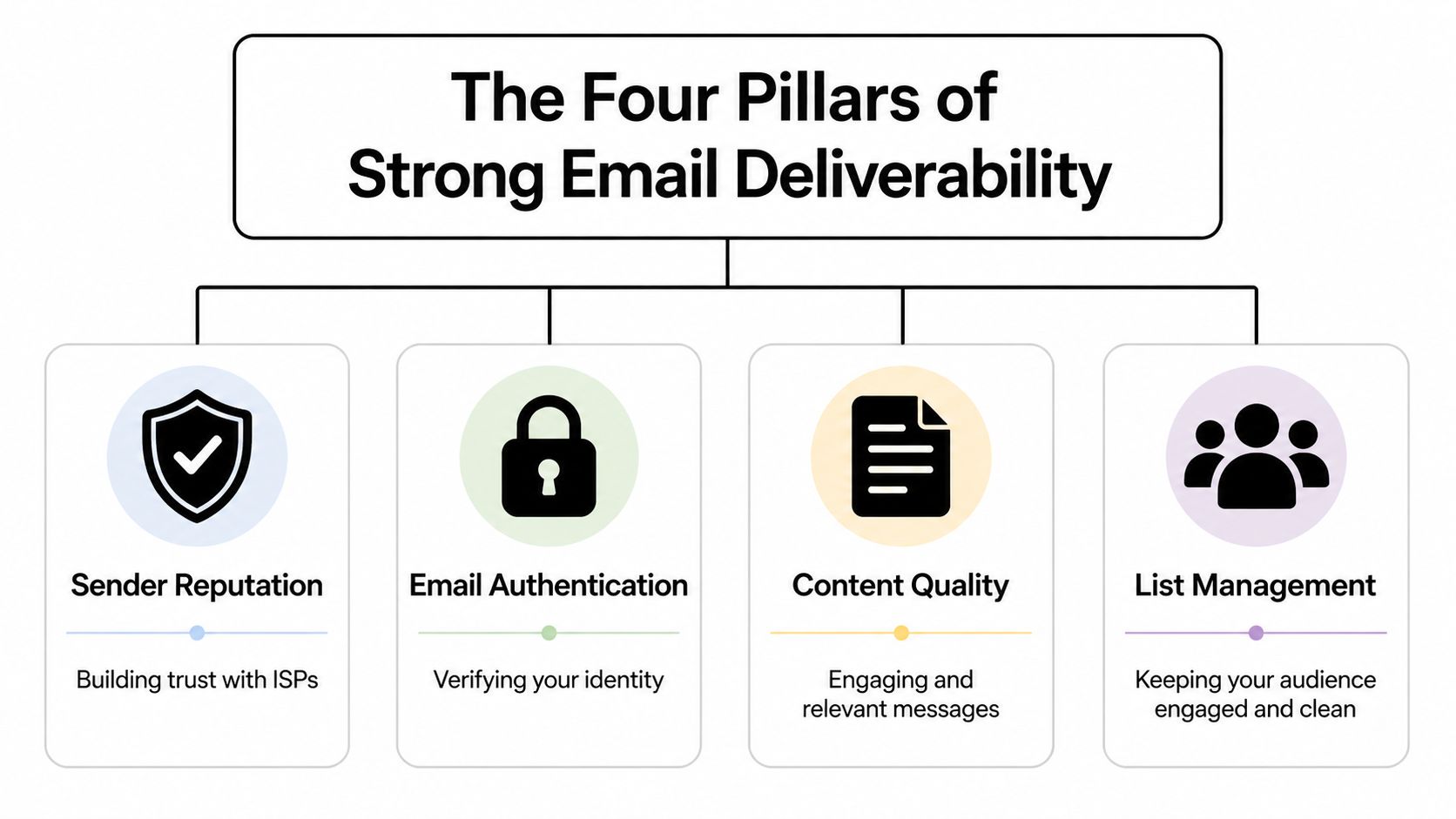
Authentication proves you are who you say you are
SPF, DKIM, and DMARC verify that your emails are being sent by approved systems and that the message has not been altered in transit. Mailbox providers use those records to decide whether your domain looks legitimate before they weigh engagement and reputation.
For a Shopify brand, this is a revenue issue, not just a setup task for IT. If authentication is misconfigured, a welcome series can miss first-time buyers, cart emails can disappear during the highest-conversion window, and even order-related messages can be put at risk.
A few practical realities matter here:
- SPF validates sending sources so providers know which services can send on your behalf
- DKIM signs the message so providers can verify integrity
- DMARC checks alignment and gives your team visibility into failures and abuse
Getting this right does not guarantee inbox placement. Getting it wrong creates preventable problems before actual deliverability work even starts.
Sender reputation decides how much trust you get
Reputation is the score mailbox providers build from your sending behavior over time. They look at the history of your domain and sending infrastructure, then make a judgment about future mail. That judgment affects whether your next campaign lands in the inbox, promotions tab, spam folder, or nowhere useful.
Ecommerce teams often lose money without noticing. A brand can have strong products, polished design, and a healthy list on paper, then hurt performance by hammering unengaged segments with daily promos. The immediate result is lower response. The longer-term result is weaker placement for the flows that drive margin.
A few patterns consistently hurt reputation:
- Old lists: inactive contacts ignore, delete, or complain more often
- Sudden volume spikes: sharp jumps can look suspicious after quiet periods
- Mixed mail streams: promotional mail can drag down more trusted operational traffic
Operator’s view: Reputation builds slowly and drops quickly. Every low-quality send makes the next high-value send harder to place.
For larger brands, infrastructure choices matter too. Shared sending environments can work well, but they give you less insulation from outside noise. Dedicated setups give you more control, but only if the team manages warming, segmentation, and sending cadence with discipline.
Audience engagement tells providers whether your mail is wanted
Mailbox providers pay attention to recipient behavior. Clicks, replies, deletions, complaints, and repeated ignoring all influence future placement. Opens can still be directionally useful, but they are no longer strong enough to use in isolation.
This is why deliverability and lifecycle strategy are tied together. Better targeting usually improves both inbox placement and revenue per recipient. Worse targeting usually hurts both.
A few ecommerce examples make the trade-off clear:
Welcome flow relevance
A subscriber who joined through a 10% off popup should get a clear, timely series tied to that promise. If the first email is generic or delayed, engagement drops before the relationship starts.Cart recovery timing
A cart email sent while purchase intent is still high will usually outperform a broad discount blast sent the next day to the whole list. It also sends a better engagement signal to mailbox providers.Post-purchase logic
Replenishment, cross-sell, and review requests perform better when they reflect what the customer bought and when they are likely to need it again.
The inbox is earned through relevance. In practice, brands that improve segmentation and flow logic often see deliverability gains show up as revenue gains first.
Content and list management keep the system stable
Content problems are usually relevance problems wearing a creative costume. Mailbox providers and customers both react badly when the subject line overpromises, the body feels cluttered, or the offer does not match the audience.
List management is the stabilizer. If too much of the file is stale, every send gets weaker engagement, more complaints, and more placement risk. That is one reason deliverability can become a lever for store growth. Cleaning up low-quality segments may reduce list size, but it often improves the performance of the list that still matters.
Here’s the practical version:
| Area | What works | What usually fails |
|---|---|---|
| Subject lines | Clear expectations, relevance, consistency | Clickbait, bait-and-switch framing |
| Email body | Clean design, obvious hierarchy, useful CTA | Overloaded layouts, too many competing links |
| Segmentation | Behavior-based targeting, recency-aware sends | Batch-and-blast to everyone |
| List hygiene | Removing invalid and inactive contacts | Continuing to email dead weight |
I’ve seen brands add meaningful revenue without increasing send volume through fixing these basics. Better segmentation, cleaner lists, and tighter creative often raise inbox placement enough to recover more abandoned carts and convert more first-time subscribers.
If you want a more detailed operating checklist, these email deliverability best practices for ecommerce brands pair well with the framework above.
How to Measure and Benchmark Your Deliverability
A healthy-looking campaign report can still hide a revenue problem.
An abandoned cart flow with a strong conversion rate on paper does not help much if 10 percent to 15 percent of those emails never reach the inbox. For a Shopify brand, that is not a reporting issue. It is missed revenue from high-intent shoppers who were ready to buy.
In 2024, global inbox placement averaged 83 to 85 percent, with 6 to 7 percent landing in spam. Retail and ecommerce performed a bit better at 87 to 88 percent, according to email deliverability benchmarks. Even there, more than one in ten messages still went unseen. That is a large enough gap to change monthly store revenue, especially in welcome, browse abandonment, and post-purchase flows.
The metrics that matter
Start by separating visibility metrics from business metrics. You need both.
Visibility metrics show whether mailbox providers trust your mail enough to place it in front of a customer. Business metrics show whether that visibility turns into clicks, orders, and repeat purchases. If you only track the second group, you spot the problem late. If you only track the first group, you miss the revenue impact.
Focus on these:
Inbox placement rate
The clearest read on whether customers have a chance to see the message.Spam placement rate
A rising spam rate often shows up as weaker flow revenue before a team notices a technical issue.Hard and soft bounces
Hard bounces point to list quality problems. Soft bounces can signal volume, throttling, or temporary mailbox issues.Spam complaint rate
Complaint rate is one of the fastest ways to damage sender reputation. Gmail’s complaint threshold matters because of its scale in consumer email. Google documents its sender requirements and recommends keeping spam complaint rates below 0.3 percent in Email sender guidelines.Clicks and downstream conversion
Open data is less reliable than it used to be. Clicks, sessions, and placed orders are better indicators of whether email is reaching real shoppers and driving sales.
Benchmarks to use with caution
Benchmarks are useful as guardrails, not as goals by themselves.
A campaign can post a strong open rate and still underperform if inbox placement is weak or tracking is inflated by Apple Mail Privacy Protection. I have seen brands celebrate open rates while welcome flow revenue was slipping for three straight weeks. The issue was not creative. Gmail placement had dropped, and the drop showed up in store sales before anyone found it in the ESP.
Use these ranges as directional checks:
| Signal | Healthy benchmark |
|---|---|
| Bounce rate | Below 2 percent |
| Unsubscribe rate | Below 0.1 percent |
| Real open rate | Around 24 percent |
| Good deliverability | Above 89 percent |
| Excellent deliverability | Above 95 percent |
The better benchmark is your own history by mailbox provider, campaign type, and flow. Compare this month’s Gmail performance to your prior Gmail baseline. Compare your abandoned cart flow to its trailing 60-day average. That is usually where revenue leaks show up first.
The tools worth checking regularly
An ecommerce team does not need a large deliverability stack. It needs a repeatable review process tied to revenue.
Use a short measurement stack:
- Your ESP dashboard for trends by campaign, flow, segment, and mailbox provider when available
- Google Postmaster Tools for domain reputation, spam rate, and authentication insight
- Seed testing or inbox placement tools when you suspect provider-specific filtering
- Revenue reporting in Shopify, Klaviyo, or your BI tool to connect placement changes to sales changes
For a broader reporting framework, this guide to email campaign performance metrics helps separate useful indicators from noise. If you are mapping deliverability into a wider growth plan, these scalable ecommerce tactics for 2026 are a useful companion.
Review trends weekly, not only after a bad campaign. That habit catches inbox placement problems while they are still small enough to fix before they cut into your Shopify revenue.
An Actionable Deliverability Playbook for Ecommerce Brands
Your team launches a big sale, traffic is up, SMS is converting, and paid social is doing its job. Email should be printing revenue. Instead, the welcome flow slows down, abandoned cart underperforms, and repeat purchase campaigns miss plan. In a lot of Shopify stores, that gap is not a copy problem or an offer problem. It is an inbox placement problem.
That is why deliverability belongs in the revenue playbook, not buried in ESP settings. If your emails stop reaching the primary inbox, high-intent flows lose power first. A weak sender reputation can quietly cut the output of your best automations, especially welcome, browse abandonment, cart recovery, and post-purchase cross-sell.
Before a launch or migration, warm up like revenue depends on it
If you switch ESPs, change sending domains, or add a new subdomain, do not send your full promotional file on day one. Mailbox providers do not know your new setup yet. They judge it by the first engagement signals they see.
Start with the subscribers most likely to act like real customers:
- Recent purchasers
- Recent clickers
- Active subscribers in core flows
- Loyalty members or VIPs who engage consistently
That first wave helps establish trust. Then increase volume in stages.
I usually tell ecommerce teams to treat warm-up like opening a new retail location. You do not start with your biggest holiday crowd. You start with your best customers, prove the experience is solid, and then scale traffic.
Avoid three expensive mistakes during warm-up:
- Sending to cold or aging segments too early
- Stacking a major sale on top of brand-new infrastructure
- Changing platform, domain, and from-name at the same time
If your retention program is growing alongside acquisition, this round-up of scalable ecommerce tactics for 2026 is useful context. Growth works better when your paid traffic, list growth, and sending reputation stay in sync.
Split transactional mail from promotional mail
Order confirmations and shipping updates should not share the same reputation risk as your weekend sale blasts.
Transactional emails are usually expected and opened fast. Promotional campaigns are less predictable. If both streams ride on the same setup, a rough promotional period can spill into the emails customers need to receive.
A practical structure looks like this:
| Stream | Best practice |
|---|---|
| Transactional | Use a dedicated subdomain or sending stream |
| Promotional | Tight segmentation and controlled frequency |
| Lifecycle automations | Prioritize timing, relevance, and conversion intent |
For Shopify brands, this matters in plain revenue terms. If promotional reputation slips, you can still protect order and account emails. If lifecycle emails are managed carefully, your abandoned cart and welcome series have a better chance of staying in the inbox where they drive sales.
Cut list risk before peak season
Peak season creates bad sending behavior. Teams get nervous, widen targeting, and mail old subscribers who have not engaged in months. That decision can hurt placement right when every inbox impression is worth more.
Use a revenue filter before high-volume periods:
- Keep recent engagers in the main campaign audience
- Lower frequency for colder subscribers
- Suppress people with no recent interest signals
- Watch complaints and bounces closely as volume climbs
A smaller audience can produce more Shopify revenue if it gets better inbox placement. I have seen brands send to 30 percent fewer profiles and make more money because the messages landed where customers could see them.
Put a sunset policy into the ESP, not a slide deck
Dead weight on your list is not harmless. Repeatedly mailing subscribers who never open, click, or buy teaches mailbox providers that your mail is less wanted.
A sunset policy fixes that. Define clear rules for when a subscriber moves from active, to at-risk, to suppressed. The exact timeline depends on your purchase cycle. A consumables brand can be more aggressive than a high-ticket furniture brand. The principle stays the same. If a contact keeps ignoring you, continued volume rarely creates revenue and often weakens future placement.
A subscriber who never engages stops being an asset. They become a reputation cost.
The brands that handle deliverability well do one thing consistently. They make these rules operational. Warm-up plans, stream separation, seasonal suppression, and sunset logic should live inside your ESP and campaign calendar, where they protect revenue every week.
Your Troubleshooting Checklist When Open Rates Drop
When opens suddenly fall, don't panic and rewrite everything. Diagnose the sending environment first.
If performance dropped overnight
Start with the basics:
Check authentication status
Confirm SPF, DKIM, and DMARC are still passing. Small infrastructure changes can break alignment.Review sending changes
Did you change your from-name, sending domain, or platform setup?Look at audience selection
Did you just include an older, colder, or imported segment?Check provider feedback
Review Google Postmaster Tools and your ESP alerts for reputation shifts or blocking patterns.
If campaigns dropped but flows still perform
That usually points to a campaign-specific issue rather than a total deliverability collapse.
Check these areas:
- Segmentation quality for the campaign audience
- Send frequency in the days leading up to the drop
- Creative mismatch between subject line and offer
- Promotion-heavy cadence that trained subscribers to ignore messages
If flows remain healthy, the problem may be your campaign strategy rather than your whole domain reputation.
If transactional mail is affected too
Treat that as urgent. When order and service emails decline, customers feel it immediately.
Use a short escalation checklist:
| Symptom | Check first |
|---|---|
| Order emails delayed or unseen | Sending stream separation and authentication |
| Broad drop across all email types | Domain reputation and provider-level filtering |
| High bounce activity | Recent list additions and data quality |
| Sharp unsubscribe or complaint reaction | Recent content and targeting choices |
Check the mailbox provider signals before you blame subject lines. Creative problems usually don't break everything at once.
A troubleshooting process works best when someone owns it. One person should gather provider data, one should review audience changes, and one should inspect infrastructure. If everyone guesses, nobody diagnoses.
Stop Losing Revenue to the Spam Folder
A founder looks at Klaviyo, sees emails sent, and assumes the channel is working. Then abandoned cart revenue comes in light, welcome flow conversion stalls, and repeat purchase campaigns underperform. In many cases, the problem is not the offer. The messages were never seen.
That is the business case for deliverability.
Inbox placement decides how much revenue your email program can produce in Shopify. If a cart reminder hits spam, the lost opportunity is immediate. If a welcome series misses the inbox, you lose the best chance to turn a new subscriber into a first-time buyer. If post-purchase and replenishment emails get filtered, you give up repeat revenue you already paid to acquire.
I have seen brands spend weeks rewriting subject lines and redesigning templates when the underlying issue was simpler. Poor inbox placement was choking performance before the customer ever had a chance to click. Delivery says the provider accepted the message. Deliverability decides whether the customer sees it in time to buy.
That is why deliverability should be treated as a revenue control, not a background technical task. Better authentication, cleaner list management, smarter segmentation, and stronger engagement signals usually improve the performance of the flows that matter most to ecommerce brands. In our work with ecommerce stores, fixing those issues often increases the revenue captured from existing email traffic, especially in high-intent flows like welcome, cart, browse abandonment, and winback.
In practical terms, email deliverability is your ability to turn sends into inbox placement, inbox placement into clicks, and clicks into store revenue.
If email revenue feels low relative to your list size and traffic, do not assume demand disappeared. Check whether your emails are reaching the inbox consistently enough to convert.
If you suspect deliverability is holding back your store, Ecommerce Boost can help you find the issue fast. Their team works with ecommerce brands to audit lifecycle flows, list quality, segmentation, authentication, and inbox placement so you can stop guessing and build a clearer path to more revenue from email.
Free 30-minute strategy call
Get your emails back in the inbox
Deliverability problems quietly cap what email earns. On a free 30-minute call we’ll check your setup and sending habits and tell you exactly what to fix.
$20M+ in email revenue generated for clients · 400+ brands · Klaviyo & Omnisend partner
Or explore our ecommerce email marketing services.
Prefer email to a call?
Tell us about your store and we’ll reply by email.
Four quick details. JP or the team will email you back with whether we’re a fit and how we’d approach your email and SMS. No call needed to start.


